
(Steps Shown) For (a)-(d) indicated whether the researcher committed a Type 1 error, a Type 2 error or no error in hypothesis testing: . Assume there is a strong
Question: For (a)-(d) indicated whether the researcher committed a Type 1 error, a Type 2 error or no error in hypothesis testing:
- . Assume there is a strong , negative relationship between variable X (number of miles bicycled in a given week) and variable Y (amount of weight, in pounds, lost during that week of bicycling) in the population of new riders of bicycles in the United States. That is, the more miles new riders complete in a given week, the greater will be their reduction in weight during that week (the greater will be their weight lost that week). As with any exercise study, researchers investigating the relationship between X and Y are not aware of the true relationship in the population, so researchers must conduct studies with samples and then use inferential statistics to make decisions whether to reject the null hypothesis (Ho: There is no relationship between X and Y) or fail to reject the null hypothesis. A local researcher wishes to study the relationship between X and Y and he samples, during the fall semester, college students who are not regular bicycle riders and asks them to ride bicycles during the third week of the semester and record both their miles ridden and weight lost during that week. After collecting relevant data, the researcher finds a strong, negative relationship between X and Y and rejects the null hypothesis. The local researcher infers there is negative relationship between X and Y in the population of new bicycle riders.
- . Assume there is a weak , negative relationship between variable X (number of miles bicycled in a given week) and variable Y (amount of weight, in pounds, lost during that week of bicycling) in the population of new riders of bicycles in the United States. That is, the more miles new riders complete in a given week, the greater will be their reduction in weight during that week (the greater will be their weight lost that week). As with any exercise study, researchers investigating the relationship between X and Y are not aware of the true relationship in the population, so researchers must conduct studies with samples and then use inferential statistics to make decisions whether to reject the null hypothesis (Ho: There is no relationship between X and Y) or fail to reject the null hypothesis. A local researcher wishes to study the relationship between X and Y and he samples, during the fall semester, college students who are not regular bicycle riders and asks them to ride bicycles during the third week of the semester and record both their miles ridden and weight lost during that week. After collecting relevant data, the researcher finds a strong , negative relationship between X and Y and rejects the null hypothesis. The local researcher infers there is negative relationship between X and Y in the population of new bicycle riders.
- . Assume there is no relationship between variable X (number of miles bicycled in a given week) and variable Y (amount of weight, in pounds, lost during that week of bicycling) in the population of new riders of bicycles in the United States. That is, the more miles new riders complete in a given week, the greater will be their reduction in weight during that week (the greater will be their weight lost that week). As with any exercise study, researchers investigating the relationship between X and Y are not aware of the true relationship in the population, so researchers must conduct studies with samples and then use inferential statistics to make decisions whether to reject the null hypothesis (Ho: There is no relationship between X and Y) or fail to reject the null hypothesis. A local researcher wishes to study the relationship between X and Y and he samples, during the fall semester, college students who are not regular bicycle riders and asks them to ride bicycles during the third week of the semester and record both their miles ridden and weight lost during that week. After collecting relevant data, the researcher finds a strong, negative relationship between X and Y and rejects the null hypothesis. The local researcher infers there is negative relationship between X and Y in the population of new bicycle riders.
- . A researcher found a statistically significant association between miles ridden by bicycle and weight loss. If the researcher committed an error in hypothesis, which error is possible?
Deliverable: Word Document 
![[Solution Library] Assume you obtained the following](/images/solutions/MC-solution-library-76239.jpg "[Solution Library] Assume you obtained the following results for") [Solution Library] Assume you obtained the following results for
[Solution Library] Assume you obtained the following results for
 (See Steps) An ANOVA was conducted for two groups of students, one
 (See Solution) An F-ratio of 0.00 tells what about the group
![[Solution] The following ANOVA summary table was](/images/solutions/MC-solution-library-76242.jpg "[Solution] The following ANOVA summary table was obtained for a") [Solution] The following ANOVA summary table was obtained for a
[Solution] The following ANOVA summary table was obtained for a
![[All Steps] Research in psychology indicates that](/images/solutions/MC-solution-library-76243.jpg "[All Steps] Research in psychology indicates that job satisfaction") [All Steps] Research in psychology indicates that job satisfaction
[All Steps] Research in psychology indicates that job satisfaction
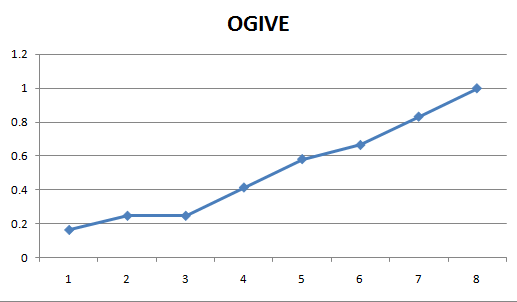 Ogive Graph Maker - MathCracker.com