Chapter 4 - Probability A bag contains 6 red marbles, 3 blue marbles, and 7 green marbles. If a marble
Chapter 4 – Probability
A bag contains 6 red marbles, 3 blue marbles, and 7 green marbles. If a marble is randomly selected from the bag:
- What is the probability that it is blue?
- What is the probability that it is green?
- What is the probability that it is red?
- What is the probability that it is yellow?
- What is the probability that is blue or green?
-
What is the probability that is red or green?
A bag contains 4 purple marbles, 10 yellow marbles, and 8 orange marbles. If two marbles are selected from the bag: - What is the probability that an orange then a yellow are chosen with replacement?
- What is the probability that a purple then an orange are chosen without replacement?
- What is the probability that two yellows are chosen with replacement?
-
What is the probability that two yellows are chosen without replacement?
Answer the question, considering an event to be "unusual" if its probability is less than or equal to 0.05. - Assume that one student in your class of 27 students is randomly selected to win a prize. Would it be "unusual" for you to win?
Chapter 5 – Discrete Probability Distributions
- What is a probability distribution? What are the two requirements of it?
-
Is the following a probability distribution? If yes, find the mean and standard deviation using the table.
x P(x) \[x\cdot P(x)\] \[{{x}^{2}}\] \[{{x}^{2}}\cdot P(x)\] 0 0.23 1 0.43 2 0.34 Total Total= Total= \[{{\mu }^{2}}=\] \[{{\sigma }^{2}}=\]
\[\mu =\] ______ \[\sigma =\] ______ -
Is the following a probability distribution? If yes, find the mean and standard deviation using the table.
x P(x) \[x\cdot P(x)\] \[{{x}^{2}}\] \[{{x}^{2}}\cdot P(x)\] 0 0.15 1 0.52 2 0.32 Total Total= Total= \[{{\mu }^{2}}=\] \[{{\sigma }^{2}}=\]
\[\mu =\] ______ \[\sigma =\] ______ -
Is the following a probability distribution? If yes, find the mean and standard deviation using the table.
x P(x) \[x\cdot P(x)\] \[{{x}^{2}}\] \[{{x}^{2}}\cdot P(x)\] 0 0.18 1 0.32 2 0.27 3 0.23 Total Total= Total= \[{{\mu }^{2}}=\] \[{{\sigma }^{2}}=\]
\[\mu =\] ______ \[\sigma =\] ______ -
Calculate the probability of the following binomial distribution using the formula.
n = 5, x = 4, p = 0.2, q = 0.8 \[P(x)=\frac{n!}{(n-x)!x!}\cdot {{p}^{x}}\cdot {{q}^{n-x}}\] - A procedure is repeated n = 6 times, use table A – 1 to find the probability of x = 5 successes given the probability p = 0.99 of success on a given trial.
-
Calculate the probability of the following binomial distribution using the formula.
n = 6, x = 2, p = 0.45 - A procedure is repeated n = 11 times, use table A – 1 to find the probability of x = 7 successes given the probability p = 0.50 of success on a given trial.
- Use the values of n = 186 and p = 0.13 to find the minimum and maximum usual values for this binomial distribution.
Chapter 6 – Normal Probability Distributions
Use the following uniform density curve to answer the problems 1 to 4. Start by calculating the appropriate "width".
P(x)
?
0 2.5 5 x
- What is the probability that the random variable has a value greater than 0.4?
- What is the probability that the random variable has a value less than 2.0?
- What is the probability that the random variable has a value between 1.5 and 3.5?
- What is the probability that the random variable has a value between 1.0 and 4.5?
- Find the probability of a randomly selected value is less than 1.67?
- Find the probability of a randomly selected value is less than –2.12?
- Find the probability of a randomly selected value is greater than 0.6?
- Find the probability of a randomly selected value is greater than 2.45?
- Find the probability of a randomly selected value is greater than –1.61 but less than 1.61?
- Find the z score that corresponds to the 86 th percentile.
- Find the z score that corresponds to the area of 0.3461.
- Find the values separating the top 5% and the bottom 5%. What percentage of values will fall between these scores?
- Suppose that replacement times for washing machines are normally distributed with a mean of 9.3 years and a standard deviation of 1.1 years. Find the probability that a randomly selected washing machine will have a replacement time less than 9.1 years.
- A final exam in Math 260 is normally distributed and has a mean of 73 with a standard deviation of 7.8. If a student is randomly selected, find the probability that their test score is less than 75.
- Using the mean and standard deviation from the previous problem, find the test score that will separate the bottom 90% from the top 10%.
Deliverable: Word Document

-
 (See) . Does Ephemeral Products, Inc., practice sex discrimination
-
(See Solution) Use the Minitab output in the Exhibit for questions (1)-(8).
-
[Solution] You were recently hired as the vice president of marketing
-
(Solution Library) : Build your own table that labels what the ranges are
-
(Steps Shown) Apply your knowledge about the proper use of numerical
-
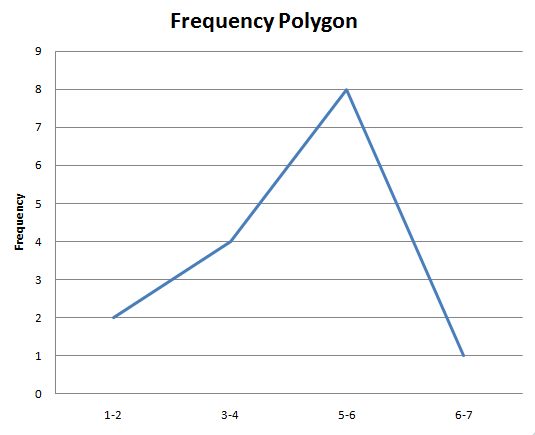
Frequency Polygon Graph Maker - MathCracker.com


![[Solution] You were recently hired as the](/images/solutions/MC-solution-library-82105.jpg "[Solution] You were recently hired as the vice president of marketing")