Country Farm Insurance Company (CFIC) uses a sales force of two people (Pat and Victoria) to visit c
Question: Country Farm Insurance Company (CFIC) uses a sales force of two people (Pat and Victoria) to visit customers in three boroughs of NYC (Manhattan, Brooklyn and Queens). CFIC can distribute a total of up to 100% of each salesperson’s 48 works weeks per year amongst the three boroughs. Fractions of weeks may be assigned as well. For example, a salesperson might spend 23% of his time in Manhattan and the remaining 77% of his time in Queens. Expected net profit per year for each sales person and borough is given in the table below. All numbers are in thousands of dollars.
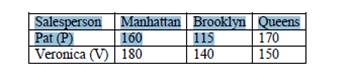
CFIC has determined that each geographic area may receive no more than a total (summed up over the two salespersons) of 43.2 work weeks assigned to it per year, or equivalently, 90% of the total of 48 work weeks. CFIC’s objective is to maximize its expected net profit per year.
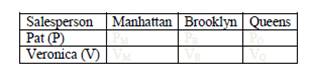
Let PM, PB, PQ be the fraction of the year that Pat will spend selling in Manhattan, Brooklyn and Queens, respectively. Similar definitions apply to VM, VB and VQ, with respect to Veronica.
a. Formulate the problem of determining the fraction of time that each salesperson will spend selling in each of the three boroughs as a linear program. Specify the objective function and all relevant constraints (Hint: At least five constraints are needed: one for each salesperson and one for each borough).
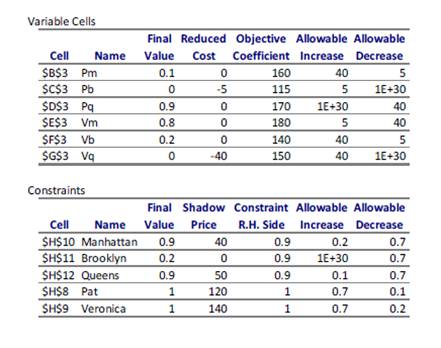
b. Consulting the sensitivity report below, determine the optimal number of weeks that each salesperson will spend selling in each borough next year. What is the optimal annual net profit? (It might be helpful to first fill in the blanks in the following table)
c. CITC has decided to authorize one of their salesperson to work overtime. Assuming that overtime hourly rate is the same as the normal hourly rate, which salesperson should be authorized to work overtime? Why should you pick this salesperson, and what is the most amount of additional annual net profit that CFIC could make from allowing this salesperson to work overtime? (Assume that a normal workweek is 40 hours, and that the maximum total number of hours a salesperson is allowed to work (including overtime) is 54).
d. Suppose that CFIC now abandons its decision to authorize overtime. At the same time, business is picking up in Queens and so CFIC decides to allow a total of 48 work weeks a year (summed over both salespersons) in Queens. The other two boroughs remain at 43.2 work weeks a year each. What now is the optimal fraction of time for each salesperson to work in each borough?
Deliverable: Word Document

-
 [Solution] Linear Programming Problem - Blending or mix. I want to make a burger using only bread and beef tota #28449
-
[Solved] Make an experimental diagram and describe the experiment to determine whether a group of 50 students #18990
-
(Solved) The stimulant Ritalin has been shown to increase attention span and improve academic performance in #23958
-
(Solved) The following are the tax refunds (or payments; i.e. (125) = negative number; therefore (125) is equ #24407
-
Free Math Help
-
Math and Statistics Solutions