
(All Steps) Use Newton's divided differences set out in tabular form as in notes to find a quadratic approximation for e^x using x=0,1,2, and use this to
Question: Use Newton's divided differences set out in tabular form as in notes to
- find a quadratic approximation for \(\mathrm{e}^{\mathrm{x}}\) using \(\mathrm{x}=0,1,2\), and use this to find an approximation for \(\mathrm{e}^{\mathrm{x}}\) at \(\mathrm{x}=1.5\)
- extend this approximation to a cubic using \(\mathrm{x}=3\), and use this to find an approximation for \(\mathrm{e}^{\mathrm{x}}\) at \(\mathrm{x}=1.5\)
- compare the above approximations with the value of \(\mathrm{e}^{\mathrm{x}}\) at \(\mathrm{x}=1.5\).
Deliverable: Word Document 
![[Solution] For the differential equation (d y)/(d](/images/solutions/MC-solution-library-52947.jpg "[Solution] For the differential equation (d y)/(d x)=(y^2+y)/(x),") [Solution] For the differential equation (d y)/(d x)=(y^2+y)/(x),
[Solution] For the differential equation (d y)/(d x)=(y^2+y)/(x),
 (Steps Shown) Consider a normal distribution with mean 20 and
![[Solution Library] The distribution of weights of](/images/solutions/MC-solution-library-52949.jpg "[Solution Library] The distribution of weights of a large group of") [Solution Library] The distribution of weights of a large group of
[Solution Library] The distribution of weights of a large group of
 (Steps Shown) The mean birth-weight for ALL the children born
 (Solution Library) Rating service at five-star hotels. A study published
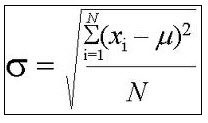 Mean and Standard Deviation Calculator - MathCracker.com