
[See Solution] A small grocery store has two checkout lines available to its customers: a regular checkout line and an express checkout line. Customers
Question: A small grocery store has two checkout lines available to its customers: a regular checkout line and an express checkout line. Customers with 5 or fewer items are expected to use the express line. Let X and Y be the number of customers in the regular checkout line and the express checkout line, respectively. Note that these numbers include the customers being served, if any. The marginal distribution of Y and the conditional distribution of X given Y are given respectively in the tables below.
| Y = 0 | Y = 1 | Y = 2 | Y = 3 |
| 0.30 | 0.20 | 0.10 | 0.40 |
| Y = 0 | Y = 1 | Y = 2 | Y = 3 | |
| X = 0 | 0.1000 | 0.2000 | 0.3000 | 0.3750 |
| X = 1 | 0.1500 | 0.3000 | 0.3000 | 0.1000 |
| X = 2 | 0.2000 | 0.2500 | 0.1000 | 0.3000 |
| X = 3 | 0.5500 | 0.2500 | 0.3000 | 0.2250 |
- What is the practical benefit of knowing the conditional distribution given?
- Calculate the joint probability distribution of X and Y.
- Find the mean and standard deviation of X .
- Calculate the conditional distribution of Y given X.
- What is the probability that no one is waiting or being served in the regular checkout line?
-
Calculate the probability P(0
- What is the probability that no more than two customers are waiting in both lines combined?
- On average, how many customers would you expect to see in each of these two lines at the grocery store? 3
- What is the probability that both lines have less than the average number of customers expected (i.e., regular checkout line has less than average number of customers AND express checkout line has less than average number of customers)?
- Are the variables X and Y independent? Show the calculations that lead to your conclusion.
- Calculate the correlation between X and Y.
Deliverable: Word Document 
 (See Solution) The IT manager at a large corporation is assessing
 (See Solution) The market research group of a clothing company
![[Steps Shown] Suppose that patrons of a](/images/solutions/MC-solution-library-51528.jpg "[Steps Shown] Suppose that patrons of a restaurant were asked") [Steps Shown] Suppose that patrons of a restaurant were asked
[Steps Shown] Suppose that patrons of a restaurant were asked
 (Solution Library) A new process for producing synthetic diamonds can
![[See Steps] Political polls typically sample randomly](/images/solutions/MC-solution-library-51530.jpg "[See Steps] Political polls typically sample randomly from the") [See Steps] Political polls typically sample randomly from the
[See Steps] Political polls typically sample randomly from the
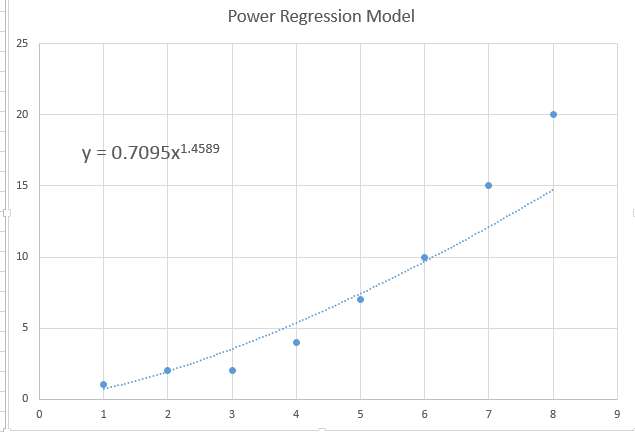 Power Regression Calculator - MathCracker.com