
(All Steps) In this exercise you are to check for normality in several ways. In the research of groundwater it is often important to know the characteristics
Question: (75 points) In this exercise you are to check for normality in several ways.
In the research of groundwater it is often important to know the characteristics of the soil at a certain site. Many of these characteristics, such as porosity, are at least partially dependent upon the grain size. The diameter of individual grains of soil can be measured. Here are diameters (in mm) of 30 randomly selected grains.
1.24
1.36
1.28
1.31
1.35
1.20
1.39
1.35
1.41
1.31
1.28
1.26
1.37
1.49
1.32
1.40
1.33
1.28
1.25
1.39
1.38
1.34
1.40
1.27
1.33
1.36
1.43
1.33
1.29
1.34
- (35 points) Construct a normal quantile plot, using quantiles of order either \(\frac{r}{n+1}\) where r denotes the r th order statistic from a sample of size n or \(\frac{2r-1}{2n}\). Include on your plot the trendline. For a complete discussion of quantiles see the Word document q-q plots and for a detailed construction of a normal quantile plot see the Excel document "TestingForNormalityExtract". Decide whether the sample data is approximately normally distributed, justifying your decision. If it is approximately normal, then estimate its mean and variance. Also, estimate the mean and the variance from the equation of the trendline, and compare the two pairs of estimates.
- (15 points) Calculate the percentage of sample values within 1, 2, and 3 standard deviations of the mean, and compare these percentages with those of the empirical rule. Does this comparison corroborate your conclusion of part (a)? Explain.
- (10 points) Calculate the Pearson coefficient of skewness (PC) (the definition is given on page 320 in Bluman). Does the value of PC corroborate your conclusion of part (a)?
- (15 points) Check for outliers. Recall that values lying in \(\left( -\infty ,{{Q}_{1}}-3*IQR \right)\) are called lower outliers and values lying in \(\left( {{Q}_{3}}+3*IQR,\infty \right)\) are called upper outliers; here IQR (interquartile range) denotes the difference between the third quartile Q3 and the first quartile Q 1 . Values lying in \([{{Q}_{1}}-3*IQR,{{Q}_{1}}-1.5*IQR)\) ) are called suspected lower outliers and values lying in \(({{Q}_{3}}+1.5*IQR,{{Q}_{3}}+3*IQR]\) are called suspected upper outliers. Does the existence or non-existence of outliers corroborate your conclusion of part (a)?
Note: Please submit your normal quantile plot and any supporting printout from your Excel worksheet.
Deliverable: Word Document 
 Solution: The number of full time White House staff members can
 (Step-by-Step) The cost of manufacturing x units of a product is C(x)=x√2x+5
 (Steps Shown) The cost of manufacturing x units of a product is
![[Solution] The sum of $5000 is deposited](/images/solutions/MC-solution-library-72287.jpg "[Solution] The sum of $5000 is deposited in an account paying") [Solution] The sum of $5000 is deposited in an account paying
[Solution] The sum of $5000 is deposited in an account paying
 (Step-by-Step) According to the National Highway Traffic Administration,
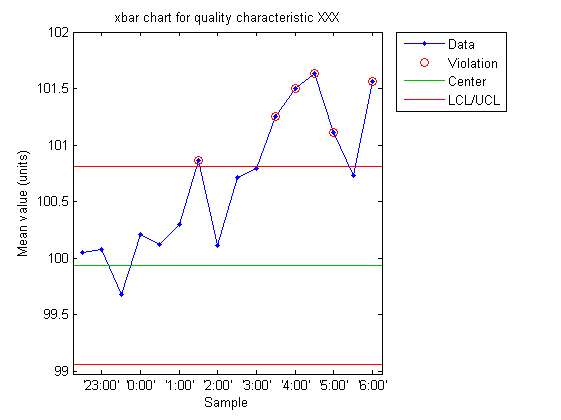 Xbar Chart Maker - MathCracker.com