
[Solution Library] You are a crop consultant helping a grain farmer in Wisconsin’s Central Sands determine his economically optimal irrigation level. Using
Question: You are a crop consultant helping a grain farmer in Wisconsin’s Central Sands determine his economically optimal irrigation level. Using records for different fields over the last few years, you calculated his average yield for different levels of total water during the growing season. Fill in the table below and answer the following questions.

When he plants, he forward contracts his corn at a price of $5.00/bu. The cost of pumping one acre inch of water is $10.00 per acre inch.
- Suppose your client typically makes sure his corn gets 20 inches of water and this year he wants to go with 22 inches. Explain to him why this is not a good move if he wants to maximize his net returns. When he goes from 20 to 22 inches, how much does his average yield increase? How much is this extra yield worth? How much will it cost him to pump these extra 2 inches?
- If he wants to maximize his net returns, how much water should he plan on making sure his corn has (Note: you may need to interpolate between table entries)? At this amount of water, what is his average corn yield and what is its value at $5.00/bu? What will it cost to pump this much water if pumping costs $10.00 per acre inch? Assuming he has $1000/ac in other costs, what are his net returns per acre?
- Suppose he replaces his high pressure irrigation system with a more efficient low-pressure system that uses less energy and wastes less water, and as a result, pumping costs fall to $5.50 per acre inch. If he wants to maximize his net returns, how much water should he plan on making sure his corn has?
- Suppose a group wants to reduce agricultural use of water in the area and to do so, they are offering farmers subsidies to replace older irrigation systems with these new more efficient low pressure systems that waste less water and so have lower pumping costs per acre-inch (like in problem 1c). Their logic is that with these new more efficient systems, farmers will pump less water per acre. These new systems are more expensive to buy and install (say $150,000) than a conventional system (say $100,000), but once in place, the new systems are more efficient and so have a lower cost to pump an inch of water. Comment on how effective you think this program will be at reducing water use for crop production. When he plants, he forward contracts his corn at a price of $5.00/bu.
Deliverable: Word Document 
![[See Steps] You are the same crop](/images/solutions/MC-solution-library-72804.jpg "[See Steps] You are the same crop consultant as in problem 1,") [See Steps] You are the same crop consultant as in problem 1,
[See Steps] You are the same crop consultant as in problem 1,
![[All Steps] You are (still) the same](/images/solutions/MC-solution-library-72805.jpg "[All Steps] You are (still) the same crop consultant as in problems") [All Steps] You are (still) the same crop consultant as in problems
[All Steps] You are (still) the same crop consultant as in problems
![[Solution] Your cousin owns a shop in](/images/solutions/MC-solution-library-72806.jpg "[Solution] Your cousin owns a shop in Wisconsin. Last year sales") [Solution] Your cousin owns a shop in Wisconsin. Last year sales
[Solution] Your cousin owns a shop in Wisconsin. Last year sales
![[Solution Library] You are deciding on how](/images/solutions/MC-solution-library-72807.jpg "[Solution Library] You are deciding on how many steers to put") [Solution Library] You are deciding on how many steers to put
[Solution Library] You are deciding on how many steers to put
 (See Solution) This problem continues the previous problem, so use
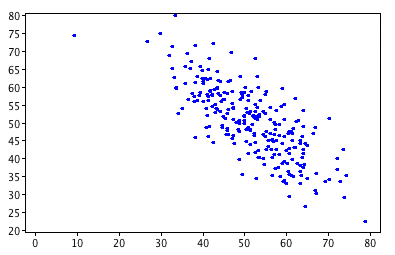 Correlation Coefficient Significance - MathCracker.com