The tables shown below contain data that describe a single unusual episode or event. Your assignment,
The tables shown below contain data that describe a single unusual episode or event. Your assignment, as a class, is to identify what this episode was. Using any of the techniques you have learned so far and any other tools you feel will help you, answer the following questions based on the data included in these tables. Don't worry about not getting the correct answer to the last question. It is more important to make an attempt to understand the story in these data than it is to get the correct answer.
Questions
- Is there a difference in the death rates of males and females?
- What does this tell you about the values of this community?
- Does age make a difference in the number of deaths (or death rate)?
- What does this tell you about this community?
- What does the number of children in relation to the number of adults tell you about this population?
- Does economic status make a difference in the death rate? Does your answer to this question differ with the subgroup you are looking at?
- What other questions would you like to ask about these data or this event in order to help you determine what it was?
- What do you think this event was?
Data
Population at Risk, Deaths, and Death Rates for an Unusual Event

Paint Can Exercise
Time for some fun practicing proportion tests!
Part 1:
Play the one-sample proportion lab. Copy and paste your sampling results. Perform a one-sample proportion significance test to determine if the proportion of yellow paint cans is 30%. State Ho, Ha, show the z-statistic and pvalue given, and state your conclusion as a full sentence.
Then report the confidence intervals for two different confidence levels (also given in the lab). What happens as the confidence level increases? What do the confidence intervals indicate? Do your confidence intervals agree with your significance test results?
Part 2:
Play the two-sample proportion lab. Record your sampling results. Perform a two-sample proportion significance test to determine if the proportion of yellow paint cans is different between the two boxes. State Ho, Ha, show the z-statistic and pvalue given, and state your conclusion as a full sentence. Comment on the confidence interval as above.
http://www4.esc.edu/stats/paintcans_onesample.html
http://www4.esc.edu/stats/paintcans_twosample.html
Written Assignment
You’re a fourth-grade teacher, and you’ve saved extensive records of all your students for the past five years. Assume that your students are a sample of all fourth-graders in your state. For each of the following questions, state what test to use, how you would set up the data and the Ho/Ha if applicable. Please use full sentences.
- What’s the major problem with your assumption?
- You’re wondering if the distribution of grades was roughly Normal. How would you check this?
- You have a nagging idea that shorter students tend to have better grades; maybe you could roughly predict a new student’s final grade by their height? And how accurate might that prediction be?
- 4th-graders in the US take a standardized test for math. The national average score is 237. Did your state outperform the national average?
- December holidays always seem such a distraction to 4th graders. Are December grades significantly worse than their October grades? If so, by how much?
- You read in a magazine that, at this age, girls often have better grades in math than the boys. Is it significant?
- In spite of that article, a fellow teacher feels that more of the boys pass math than the girls. Hmm, how would you test it?
- Maybe the girls’ scores vary more than the boys’?
- Redheads are rumored to have fiery tempers. Is there any significant difference in grades between blondes, brunettes, and redheads?
- Do more redheads fail math than students with other hair colors?
Written Assignment
Please be sure to state all answers, commentary and conclusions using full sentences.
- A company reports that the results of a phone survey indicate 80% of Americans product, with only a 3% margin of error. Do you trust this report? What problems aren’t included in a margin of error? Why are phone surveys still so common?
-
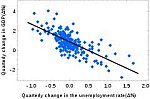
This
scatterplot
of students’ heights looks really strong. What’s wrong with it?
Women 60 61 62 62 63 64 64 65 65 65 65 67 67 67 68 70 Men 63 67 67 67 68 70 70 71 72 72 73 74 74 75 77 79 -
A student took a convenience sample of people at the local gym, asking age and weight. Using the regression equation of Weight=-1.16*Age + 214, the student predicted that a 10 year old would weigh 202.5 lbs. What’s going on here?
Age 22 24 28 30 33 35 39 42 43 49 51 55 56 62 67 Weight 130 165 180 185 250 180 175 170 170 160 160 155 155 138 100 -
A convenience sample of height data was taken, and a two-sample t-test performed, with the following result. Is the difference between men’s and women’s heights of
practical
significance? How can this happen? What can you do to check for this?
t-Test: Two-Sample Assuming Unequal Variances Men Women Mean 69.58426966 69.08427 Variance 0.722931563 0.722932 Observations 89 89 Hypothesized Mean Difference 0 df 176 t Stat 3.922847422 P(T<=t) one-tail 0.000062649 t Critical one-tail 1.653557436 P(T<=t) two-tail 0.000125298 t Critical two-tail 1.973534347 - A fourth-grade teacher takes the math scores of the 10 tallest and 10 shortest students in the class, and performs a two-sample t-test on the data. The pvalue is significant at alpha=0.05, and the teacher concludes that taller students are better at math. What are the problems with this conclusion?
Deliverable: Word Document

-
 (Steps Shown) Assignment 2 Part III You'll be using the data from Lab
-
[Solution] Pennies in Space part 1 PURPOSE : The purpose of this
-
[Solved] Assignment 6 : Find an article from a popular source
-
[Solution Library] Assignment 7: Find an article in a refereed journal
-
(Solution Library) Homework VIII (16 points) The data below are
-
Partial Correlation Calculator - MathCracker.com

![[Solution] Pennies in Space part 1 PURPOSE](/images/solutions/MC-solution-library-80830.jpg "[Solution] Pennies in Space part 1 PURPOSE : The purpose of this")
![[Solved] Assignment 6 : Find an article](/images/solutions/MC-solution-library-80831.jpg "[Solved] Assignment 6 : Find an article from a popular source")
![[Solution Library] Assignment 7: Find an article](/images/solutions/MC-solution-library-80832.jpg "[Solution Library] Assignment 7: Find an article in a refereed journal")