1.23: Show that (n , n_1,n_2,n_3,....,n_k ,)=(n-1 , n_1-1,n_2,n_3,....,n_k ,)+(n-1 , n_1,n_2-1,n_3,....,n_k
Problem 1.23: Show that
\(\left( \begin{matrix}
n \\
{{n}_{1}},{{n}_{2}},{{n}_{3}},....,{{n}_{k}} \\
\end{matrix} \right)=\left( \begin{matrix}
n-1 \\
{{n}_{1}}-1,{{n}_{2}},{{n}_{3}},....,{{n}_{k}} \\
\end{matrix} \right)+\left( \begin{matrix}
n-1 \\
{{n}_{1}},{{n}_{2}}-1,{{n}_{3}},....,{{n}_{k}} \\
\end{matrix} \right)+...+\left( \begin{matrix}
n-1 \\
{{n}_{1}},{{n}_{2}},{{n}_{3}},....,{{n}_{k}}-1 \\
\end{matrix} \right)\)
Problem 1.19:
-
Compute
\(\left( \begin{matrix}
\frac{1}{2} \\
4 \\
\end{matrix} \right)\)
and
\(\left( \begin{matrix}
-3 \\
3 \\
\end{matrix} \right)\) - Approximate \(\sqrt{5}\) using Stirling’s approximation.
Problem 5.1: If X has a discrete uniform distribution \(f(x)=\frac{1}{k}\), for \(x=1,2...,k\), show that
- The mean is \(\mu =\frac{k+1}{2}\)
- Its variance is \({{\sigma }^{2}}=\frac{{{k}^{2}}-1}{12}\).
Problem 5.2 If X has a discrete uniform distribution \(f(x)=\frac{1}{k}\), for \(x=1,2...,k\), show that its moment generating function is given by:
\[{{M}_{X}}(t)=\frac{{{e}^{t}}(1-{{e}^{kt}})}{k(1-{{e}^{t}})}\]Problem 5.6
-
Consider the probability function defined by
\[f(x)=\left\{ \begin{aligned}
& \theta \text{ if }x=1 \\
& 1-\theta \text{ if }x=0 \\
\end{aligned} \right.\]
Compute \(E\left( X \right)\) and \(\operatorname{var}\left( X \right)\) . - Define \(Y=\sum\limits_{i=1}^{n}{{{X}_{i}}}\), compute \(E\left( Y \right)\) and \(\operatorname{var}\left( Y \right)\) .
Problem 5.14:
-
Prove that
\(M_{X-\mu }^{(k)}(t)=E\left( {{(X-\mu )}^{k}}{{e}^{t(X-\mu )}} \right)\) - For a binomial distribution with parameters n and p, prove that its variance is
\(np(1-p)\)
Problem 5.20: For a probability function defined by
\(p(n)=\theta {{(1-\theta )}^{n-1}}\)
Compute the moment generating function.
Problem 5.23: Prove the "memoryless property" of the geometric distribution. This is, prove that
\(\Pr (X=x+n|X>n)=\Pr (X=x)\)
Deliverable: Word Document

-
 (Step-by-Step) 6.1: Show that if a random variable has a uniform density
-
(Solved) A t-test for a mean uses a sample of 15 observations. Find
-
[Step-by-Step] Term Project Introduction Recent growth trends in the
-
(Solution Library) LAB 3: In the chapters that follow, we are
-
[Solution Library] Solve each of these problems by computer and obtain
-
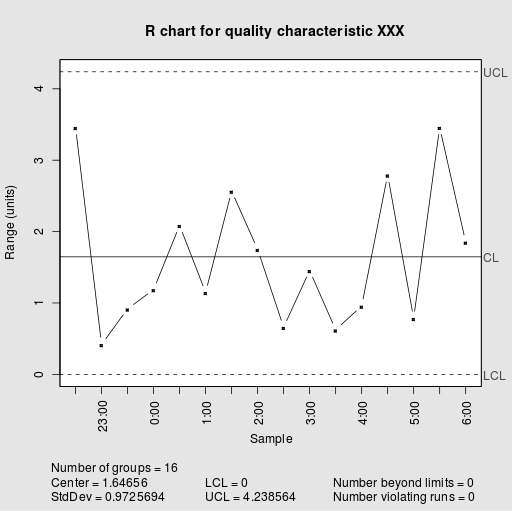
R-chart Maker - MathCracker.com


![[Step-by-Step] Term Project Introduction Recent growth trends](/images/solutions/MC-solution-library-80702.jpg "[Step-by-Step] Term Project Introduction Recent growth trends in the")

![[Solution Library] Solve each of these problems](/images/solutions/MC-solution-library-80704.jpg "[Solution Library] Solve each of these problems by computer and obtain")