QUANTITATIVE METHODS - HOMEWORK Question 1 The table below gives the time (in seconds) needed to complete
QUANTITATIVE METHODS – HOMEWORK
Question 1
The table below gives the time (in seconds) needed to complete a critical task in an assembly line for a randomly selected sample of assemblies.
| 114 | 370 | 425 | 239 | 488 | 378 | 479 |
| 309 | 165 | 217 | 345 | 511 | 292 | 375 |
| 528 | 247 | 330 | 477 | 203 | 592 | 430 |
| 428 | 453 | 624 | 380 | 392 | 322 | 622 |
| 589 | 287 | 592 | 116 | 204 | 526 | 315 |
| 339 | 201 | 172 | 498 | 293 | 444 | 571 |
1.1 Use the stem and leaf method to arrange the above data into a frequency distribution.
1.2 Draw the less-than frequency ogive for the above data.
1.3 Use the ogive drawn in 1.2 to determine:
1.3.1 The median
1.3.2 The quartile deviation
(Clearly indicate on the graph how the above values were determined.)
1.4 Determine the coefficient of variation. Interpret the result.
Question 2
2.1 An aerospace company bids on two separate government defence contracts. The company president believes that there is a 30% probability of winning the first contract. If they win the first contract the probability of winning the second contract is 80%. However if they lose the first contract the president thinks the probability of winning the second contract decreases to 50%.
2.1.1 What is the probability th at they win both contracts?
2.1.2 What is the probability tha t they lose both contracts?
2.1.3 What is the probability that they win only one contract? (3)
2.2 Because of the high interest rates, most consumers attempt to pay off their credit- card bills promptly. However this is not always possible. An analysis of the amount of interest paid monthly by a bank‘s credit-card holders reveals that the amount is normally distributed with a mean of $27 and standard deviation of $7.
2.2.1 What proportion of the cardholders pay more than $30 in interest?
2.2.2 What proportion of the cardholders pay less than $15 in interest?
2.2.3 What interest payment is exceeded by 20% of the bank‘s cardholders?
Question 3
As markets become more and more international, many firms invest in research aimed at determining the maximum possible extent of sales in foreign markets. A United States manufacturer of coffeemakers wants to find out whether the company‘s market share and the market shares of its two main competitors are about the same in three European countries to which all three companies export their products. The results of a market survey are summarized in the following table. The data are random samples of 150 customers in each country. Conduct, at the 5% level of significance, the test of equality of population proportions across the three countries.
| France | England | Spain | |
| Company | 55 | 38 | 24 |
| First Competitor | 28 | 30 | 21 |
| Second Competitor | 20 | 18 | 31 |
| Other | 47 | 64 | 74 |
Question 4
The following table gives the number of quarterly claims on household policies submitted to an insurance company during the years 2003 to 2006.
| 2003 | 2004 | 2005 | 2006 | |
| Q1 | 84 | 81 | 69 | 73 |
| Q2 | 53 | 57 | 37 | 46 |
| Q3 | 60 | 51 | 40 | 39 |
| Q4 | 75 | 73 | 77 | 63 |
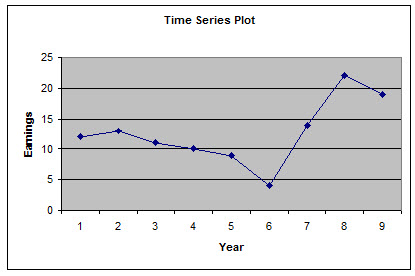
4.1 Plot the time series of household policy claims.
4.2 Isolate the trend effect by computing a least squares trend line using the zero sum method.
Comment on the trend in claims.
4.3 Estimate the quarterly seasonally effect of household policy claims. Interpret the seasonal impact.
Question 5
A company is considering whether to launch a new product. The success of the idea depends on the ability of a competitor to bring out a competing product (estimated at 60%) and the relationship of the competitor‘s price to the company‘s price. The table below gives the profits (in $‘000) for each price range that could be set by the company related to the possible competing process.
The company must set its price first so that the competitor will be able to react to the price. Estimates of the probability of a competitor‘s price are shown in the table below.
| Low Competitor’s Price | Medium Competitor’s Price | High Competitor’s Price | No Competitor | |
| Low Company Price | 30 | 42 | 45 | 50 |
| Medium Company Price | 34 | 45 | 49 | 70 |
| High Company Price | 10 | 30 | 53 | 90 |
The company must set its price first so that the competitor will be able to react to the price. Estimates of the probability of a competitor‘s price are shown in the table below.
| Low Competitor’s Price | Medium Competitor’s Price | High Competitor’s Price | |
| Low Company Price | 0.80 | 0.15 | 0.05 |
| Medium Company Price | 0.20 | 0.20 | 0.10 |
| High Company Price | 0.05 | 0.35 | 0.60 |
5.1 Draw a decision tree for the above problem.
5.2 What decision should the company take? Show all working.
Deliverable: Word Document

-
![[Solution Library] Final Exam : SPSS This](data:image/svg+xml,%3Csvg%20xmlns='http://www.w3.org/2000/svg'%20viewBox='0%200%20150%20150'%3E%3C/svg%3E "[Solution Library] Final Exam : SPSS This portion of the Final") [Solution Library] Final Exam : SPSS This portion of the Final
[Solution Library] Final Exam : SPSS This portion of the Final
-
(See Solution) Forecasting Sales The Vintage Restaurant is located
-
(Step-by-Step) Compute descriptive statistics for the following
-
[Steps Shown] Below is a picture map of 100 households in a community.
-
(See Solution) Discuss the view that a firm like Campbell Builders,
-
Easy to Use Line Chart Maker - MathCracker.com
![[Solution Library] Final Exam : SPSS This](/images/solutions/MC-solution-library-81716.jpg "[Solution Library] Final Exam : SPSS This portion of the Final")


![[Steps Shown] Below is a picture map](/images/solutions/MC-solution-library-81719.jpg "[Steps Shown] Below is a picture map of 100 households in a community.")