(Answer) A market research term has three clients who have each - #80208
Problem 1:
A market research term has three clients who have each requested that the firm conduct a sample survey. Four available statisticians can be assigned to these three projects: however. all four statisticians are busy. and therefore each can handle only one of the clients. The following data show the number of hours required for each statistician to complete each job: the differences in time are based on experience and ability of the statisticians.
|
Client | |||
|
Statistician |
A |
B |
C |
|
1 |
150 |
210 |
270 |
|
2 |
170 |
230 |
220 |
|
3 |
180 |
230 |
225 |
|
4 |
160 |
240 |
230 |
a. Formulate and solve a linear programming model for this problem.
b. Suppose that the time it takes statistician 4 to complete the job for client A is increased
from 160 to 165 hours. What effect will this change have on the solution?
c. Suppose that the time it takes statistician 4 to complete the job for client A is decreased to 140 hours. What effect will this change have on the solution?
d. Suppose that the time it takes statistician 3 to complete the job for client B increased
to 250 hours. What effect will this change have on the solution?
Solution:
(a) We have the decision variables \({{x}_{ij}}\), which is 0 or 1 depending on if the statistician i is assigned to the client j.
We need to solve the following problem:
\[\begin{aligned} & \text{Minimize}\,\,\text{ }\sum{{{C}_{ij}}{{X}_{ij}}} \\ & s.t. \\ & \,\,\,\,\,\,\,\,\,\,\,\,\,\,\,\,\,\,\,\,\,\,\,\,{{x}_{11}}+{{x}_{12}}+{{x}_{13}}\le 1 \\ & \,\,\,\,\,\,\,\,\,\,\,\,\,\,\,\,\,\,\,\,\,\,\,\,{{x}_{21}}+{{x}_{22}}+{{x}_{23}}\le 1 \\ & \,\,\,\,\,\,\,\,\,\,\,\,\,\,\,\,\,\,\,\,\,\,\,\,{{x}_{31}}+{{x}_{32}}+{{x}_{33}}\le 1 \\ & \,\,\,\,\,\,\,\,\,\,\,\,\,\,\,\,\,\,\,\,\,\,\,\,{{x}_{41}}+{{x}_{42}}+{{x}_{43}}\le 1 \\ & \,\,\,\,\,\,\,\,\,\,\,\,\,\,\,\,\,\,\,\,\,\,\,\,{{x}_{11}}+{{x}_{21}}+{{x}_{31}}+{{x}_{41}}=1 \\ & \,\,\,\,\,\,\,\,\,\,\,\,\,\,\,\,\,\,\,\,\,\,\,\,{{x}_{12}}+{{x}_{22}}+{{x}_{32}}+{{x}_{42}}=1 \\ & \,\,\,\,\,\,\,\,\,\,\,\,\,\,\,\,\,\,\,\,\,\,\,\,{{x}_{13}}+{{x}_{23}}+{{x}_{33}}+{{x}_{43}}=1 \\ & \,\,\,\,\,\,\,\,\,\,\,\,\,\,\,\,\,\,\,\,\,\,\,\,{{x}_{ij}}\in \{0,1\} \\\end{aligned}\]
Using the Management Scientist we get the following output:
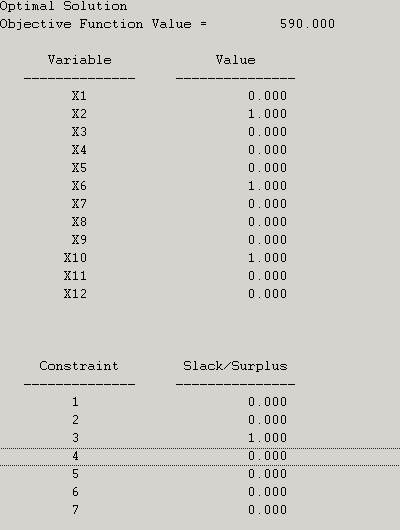
This means that the statistician 1 is assigned to job B, the statistician 2 is assigned to job C and the statistician 4 is assigned to job A.
(b) In this case we get
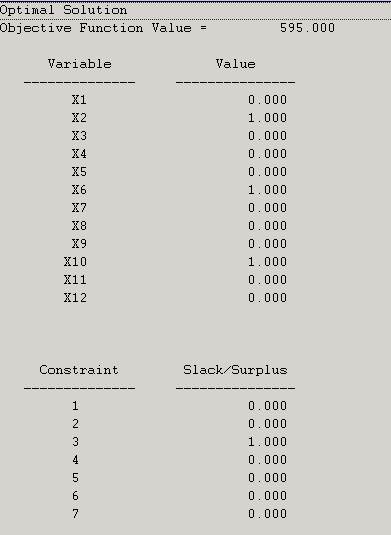
As we can see, the assignment doesn’t change, only the total time increases in 5 hours
(c) In this case we obtain:
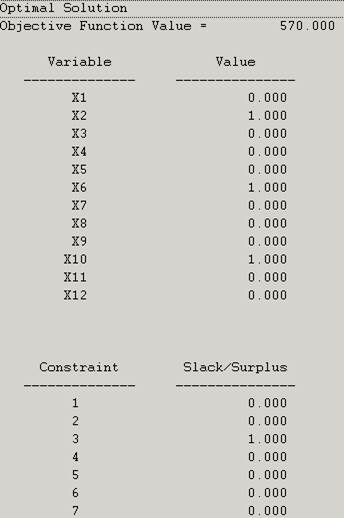
The again, the assignment doesn’t change, only the total time is reduced in 20 hours
(d) The new output is
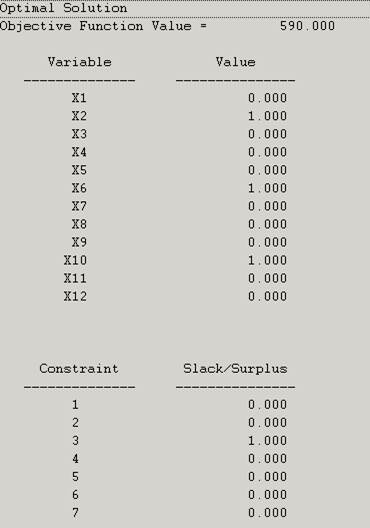
The assignment again doesn’t change.
Problem 2:
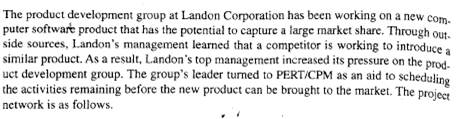
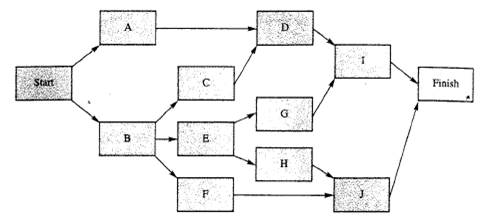
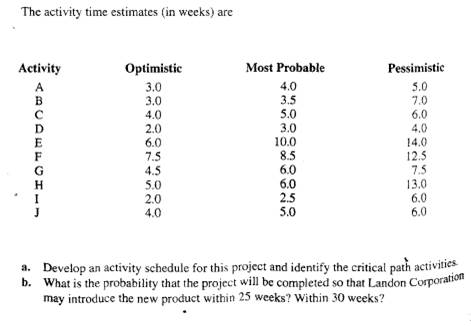
Solution: We have the following schedule:
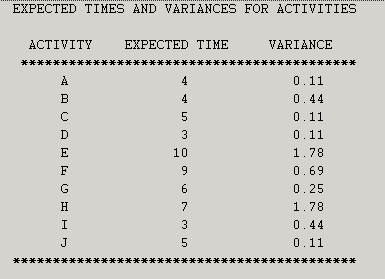
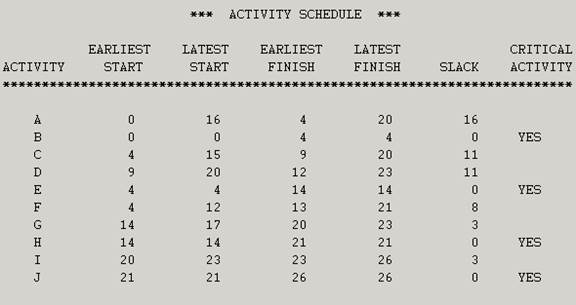

This means that the critical path is B-E-H-J. The expected completion time is 26 weeks.
(b) Let X be the completion time, we need to compute
\[\Pr \left( X<25 \right)=\Pr \left( \frac{X-26}{\sqrt{4.11}}<\frac{25-26}{\sqrt{4.11}} \right)=\Pr \left( Z<-0.49326 \right)=0.310913\]
Also,\[\Pr \left( X<30 \right)=\Pr \left( \frac{X-26}{\sqrt{4.11}}<\frac{30-26}{\sqrt{4.11}} \right)=\Pr \left( Z< \right)=0.975755\]
\
Problem 3:
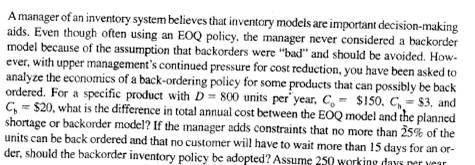
- For the EOQ we have:
|
Inventory |
Economic Order Quantity Model |
|
Data |
|
| Demand rate, D |
800 |
| Setup cost, S |
150 |
|
Holding cost, H |
3 |
| Unit Price, P |
|
|
Daily demand rate |
3.2 |
|
Lead time in days |
|
|
Results |
|
|
Optimal Order Quantity, Q* |
282.842712 |
|
Maximum Inventory |
282.842712 |
|
Average Inventory |
141.421356 |
|
Number of Setups |
2.82842712 |
| Holding cost |
$424.26 |
| Setup cost |
$424.26 |
| Unit costs |
- |
|
Total cost, Tc |
$848.53 |
| Reorder Point |
- |
- For the backorder model:
|
Inventory |
EOQ with shortages |
|
Data |
|
| Demand rate, D |
800 |
| Setup cost, S |
150 |
|
Holding cost, H |
3 |
| Shortage cost |
20 |
| Unit Price, P |
|
|
Results |
|
|
Optimal Order Quantity, Q* |
303.315 |
|
Maximum Inventory |
263.7522 |
|
Average Inventory |
114.6749 |
|
Number of Setups |
2.637522 |
|
Maximum Backorders |
39.56283 |
| Holding cost |
344.0246 |
| Setup cost |
395.6283 |
| Backorder cost |
51.60369 |
| Unit costs |
|
| Total cost |
791.2566 |
This means that the backorder model is cheaper. The difference is $848.54 - $791.2566 = $57.2834.
- In this case, the percentage of units backordered is
\[\frac{39.56283}{114.6749}\times 100=34.5%\]
which is too high. The maximum time a customer will wait for a backordered item is
\[t=\frac{S}{d}=\frac{39.56283}{3.2}=12.36\text{ days}\]
which is within the manager’s limits.
Deliverable: Word Document
 and pdf