Diagnostic tests of medical conditions have several results. The test result can be positive or neg
Question: Diagnostic tests of medical conditions have several results. The test result can be positive or negative, whether or not a patient has the condition. A positive (+) indicates the patient has the condition. A negative test (-) indicates the patient does not have the condition. Remember, a positive test does not prove the patient has the condition. Additional medical work may be required. Consider a random sample of 200 patients, some of whom have a medical condition and some of whom do not. Results of a new diagnostic test for the condition are shown:
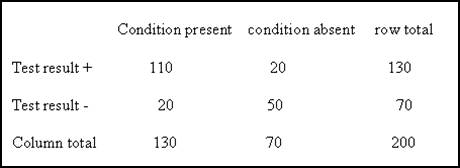
Assume the sample is representative of the entire population. For a person selected at random, compute the following probabilities.
(a) P(+, given condition present); this is known as the sensitivity of a test.
(b) P(-, given condition present); this is known as the false-negative rate.
(c) P(-, given condition absent); this is known as the specificity of a test.
(d) P(+, given condition absent); this is known as the false-negative rate.
(e) P(condition present and +); this is the predictive value of the test.
(f) P( condition present and -).
Deliverables: Word Document

-
 [Solved] In the cash now lottery game there are 10 finalists who submitted entry tickets on time. Form t #1377
-
[Solution] Find the mean, variance, and standard deviation for the following probability distribution. No. of T #3348
-
[Solved] College Athletics: Graduation Rate Women athletes at the University of Colorado, Boulder, have a lon #9348
-
[Solved] A researcher undertakes a study of physical force incidences among a sample of correctional officers #19548
-
Math and Statistics Calculator
-
Math and Statistics Answers