Life Science - The Ricker Salmon model In the Pacific Northwest, where salmon is king, the economic
Question: Life Science - The Ricker Salmon model
In the Pacific Northwest, where salmon is king, the economic survival of fishermen and many others depends on the success of the salmon fisheries. A useful mathematical model developed by W.E. Ricker in 1954 predicts how much harvesting of salmon should be done in order to achieve a maximum sustainable yield. We will examine the simplified version of Ricker’s model presented by Raymond N Greenwell and Ho Kuen Ng. The model is based on the follow six assumptions:
i) The number of eggs laid by the salmon in any generation is proportional to the number of adult salmon.
ii) If N(t) is the salmon population in the year t, then the next year’s population N(t+1) is proportional to the number of eggs laid.
iii) When the baby salmon ( called “recruits” ) reach a certain size, they eaten by predators at a rate proportional to their number.
iv) After a certain time T, the recruits become too big for most predators to swallow and their population stops decreasing.
v) The “cut-off” T is proportional to the number of eggs laid.
vi) The number of adults in the next generation is proportional to the number of recruits.
a) One way to satisfy these conditions is to require
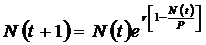
where r and P are positive constants. Suppose N(t) happens to equal P at some time. What can be said about N(t+1)? What about N(t+2)? Why is it reasonable to call P the equilibrium population?
b) If N is the population of the present generation of salmon, let the population of the next generation be given by the function
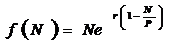
Using EXCEL, giving suitable data, draw the graph of f(N) with N on the horizontal axis. You may assume that r > 1 and that f(0) = 0. Where does the graph intersect the line y = N? What happens as N → ∞?
c) For what value of N is f(N) maximized? ( This is called the maximum recruitment level )
d) One harvesting ( fishing ) strategy is to catch all the surplus population Y(N) = f(N) – N, so, in effect, the salmon population will remain constant. The fishing industry wants the yield Y(N) to be large as possible, and this so called maximum sustainable yield occurs when Y’(N) = 0. Show that this occurs at a population N = N*, where
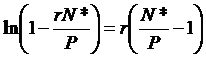
Then, find an expression for the maximum sustainable yield Y(N*) in terms of r, P, and N*.
e) Suppose r = 1.03 and the equilibrium population is P = 3000. Use EXCEL and Newton-Raphson Method to solve the equation in (d) for N* and then find the corresponding maximum sustainable yield.
Solution Format: Word Document

-
 [Solution] A recent issue of Fortune Magazine reported that the following companies had the lowest sales per em #12443
-
Solution: The following data give the speeds (in miles per hour) as measured by radar, of 10 cars traveling on #10676
-
(See Solution) The Daugherty Porta-Vac project has an expected project completion time of 17 weeks. The probability #15527
-
[Solved] The average score on the Stats midterm was 75 points with a standard deviation of 5 points, and #13955
-
Free Math Help
-
Math and Statistics Solutions