
Take a look at our list of Calculus at your fingertips
-
 [Solution] Find the derivative of r=({e^s})/(s). #17855
-
[Solution] Water is following at the rate of 50 m^3/min from a shallow concrete conical reservoir vertex do #17856
-
(Solved) About how accurately must the interior diameter of a 10 meter high cylindrical storage tank be measu #17857
-
(See Solution) The diameter of a sphere is measured as 10 +- .1 and the volume is calculated from this measureme #17858
-
[Solution] Suppose that the edge lengths x, y, and z of a closed rectangular box are changing at the follow #17859
-
[Solution] If two resistors R1 and R2, ohms are connected in parallel in an electric circuit to make an R-ohm #17860
-
Solution: Find the center of mass of D: x^2+y^2 <=9, y>=0 with density f(xy)= x^2+y^2 #17861
-
Solution: Find f'(x) if f(x)=x^2√{x^2+{a^2}}; a = constant. #17927
-
[Solved] Find (dy)/(dx) if sin (x+y)= tan (xy) #17928
-
(Solved) Find (dy)/(dx) by implicit differentiation if xy^2+√{xy}=2. #17929
-
(Solved) Find the dimensions of the rectangle of greatest area with base on the x-axis and its other two vert #17930
-
Solution: Evaluate the following integrals. (i) ∫{(x^2)/(√{1+x^3)}dx} (ii) ∫{(x-2)/({{(x^2-4x+4 #17931
-
[Solution] Find the area of the region enclosed by y=x^2-4x+4 and y = x. #17932
-
[Solved] Write the first 5 terms of the sequence: {a_n}=-2n+5 #17971
-
(Solved) Write the first 5 terms of the sequence: {a_n}=-3n-2 #17972
-
[Solved] Write the first 5 terms of the sequence: {a_n}={n^2}-2 #17973
-
[Solved] Write the first 5 terms of the sequence: {a_n}={n^2}+3 #17974
-
(See Solution) Write the first 5 terms of the sequence: {a_n}=2{n^2}-3 #17975
-
[Solution] Write the first 5 terms of the sequence: {a_n}=-2{{(3)}^{n-1}} #17976
-
Solution: Find the 10th and 15th terms of the sequence where {a_n}=-{n^2}-2n+3 #17977
-
(See Solution) Find the 7th and 8th terms of the sequence where {a_n}={{(-2)}^{n-2}} #17978
-
[Solved] A rectangular box with a volume of 60ft(3) has a square base - it has a top as well as a bottom. Fin #18039
-
[Solution] A Norman window has the shape of a rectangle surmounted by a semicircle. If the perimeter of the win #18040
-
[Solved] Evaluate the following definite integrals: (a) ∫_0^1{{t^2}dt} (b) ∫_{-1}^1{(2y^2-1)dy} (c) #18054
-
(See Solution) Determine the area bounded by the curve y=x^2-3x+7, the x axis and the ordinates at x = 1 and x = 3. #18055
-
Solution: The charge (q), in coulombs; on a capacitor can be obtained by integrating the current (i), in amper #18056
-
[Solution] Integrate: ∫{√{t}dt} #18057
-
[Solved] Integrate: ∫{{{x}^{-0.3}}dx} #18058
-
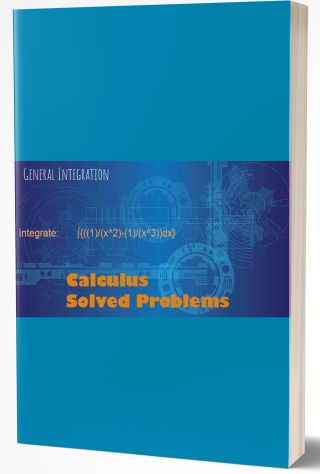
[Solved] Integrate: ∫{((1)/(x^2)-(1)/(x^3))dx} #18059
-
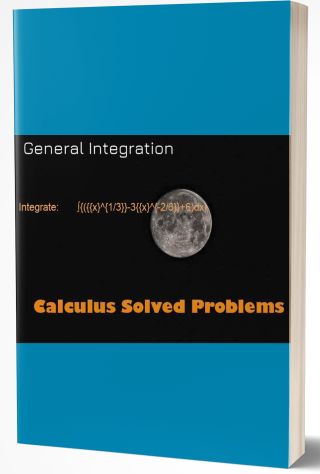
(Solved) Integrate: ∫{({{x}^{1/3}}-3{{x}^{-2/3}}+6)dx} #18060
-
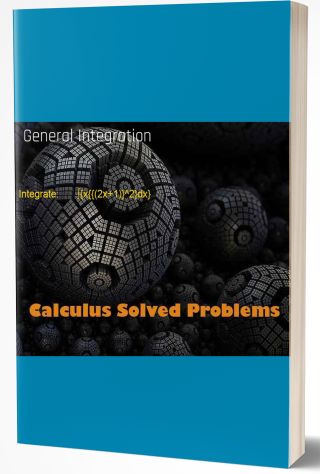
[Solved] Integrate: ∫{x{{(2x+1)}^2}dx} #18061
-
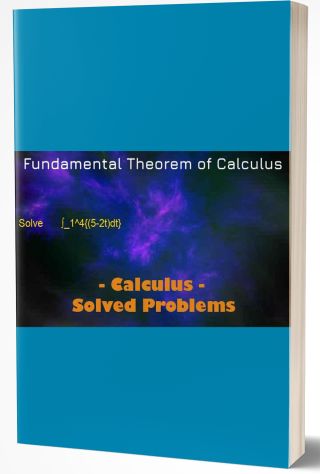
[Solved] Solve ∫_1^4{(5-2t)dt} #18062
-
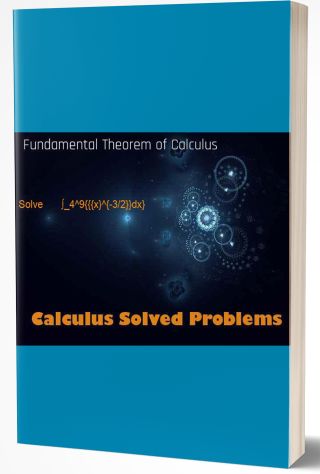
[Solved] Solve ∫_4^9{{{x}^{-3/2}}dx} #18064
-
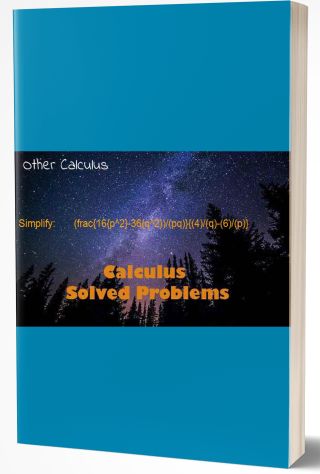
(See Solution) Simplify: (frac{16{p^2}-36{q^2})/(pq)}{(4)/(q)-(6)/(p)} #18084
-
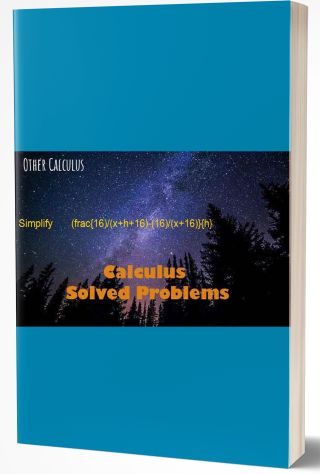
[Solution] Simplify (frac{16)/(x+h+16)-(16)/(x+16)}{h} #18085
-
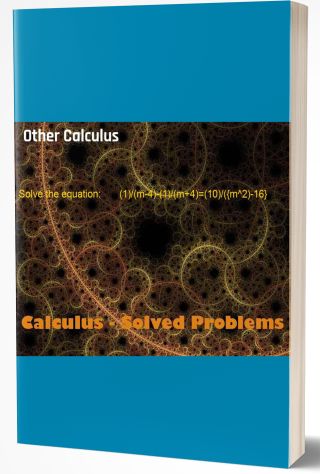
(See Solution) Solve the equation: (1)/(m-4)-(1)/(m+4)=(10)/({m^2)-16} #18087
-
[Solved] Solve the equation: (3)/(y+2)-(4)/(y-2)=(9)/(y^2-4) #18089
-
[Solved] Find the volume of the solid generated by revolving the region enclosed by y= x^2, y=4x-x^2 about th #18096
-
(See Solution) Find the arc length of the graph of the curve y=(x^4)/(8)+(1)/(4x^2) over the interval [1,2]. #18097
-
[Solved] Integrate ∫_{0}^{π }{x sin 2xdx} #18098
-
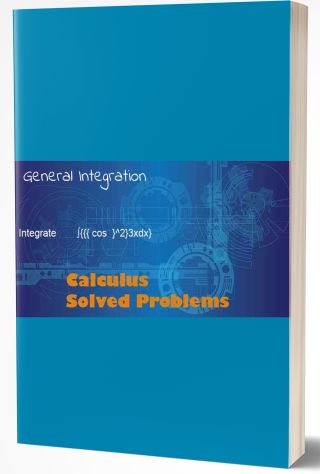
[Solution] Integrate ∫{{{ cos }^2}3xdx} #18099
-
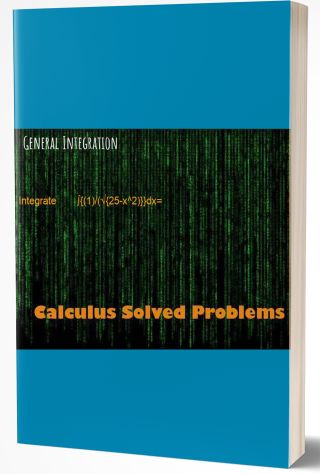
[Solved] Integrate ∫{(1)/(√{25-x^2)}}dx= #18100
-
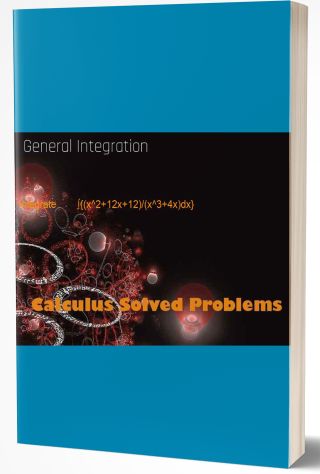
[Solved] Integrate ∫{(x^2+12x+12)/(x^3+4x)dx} #18101
-
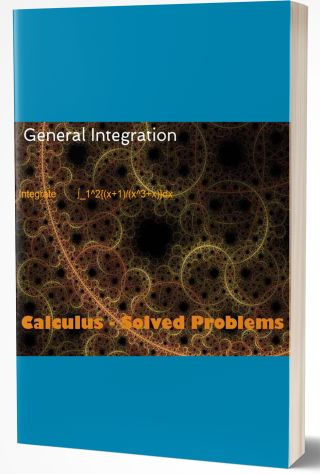
[Solution] Integrate ∫_1^2{(x+1)/(x^3+x)}dx #18102
-
[Solved] Find the limit of the improper integral ∫_{1}^{∞ }{(2x-3){e^{-x}}} #18103
-
Solution: Find the Arc length of the curve given in parametric form by, x = ?t, y = 3t - 1, 0 ? t ? 1. #18104
-
Solution: Find the equation of the tangent line in Cartesian coordinates of the curve given in polar form coor #18105
-
[Solution] The exponential function of the best fit to the data is f(x)=98* {{0.92}^x} , where weight f is a fu #18166
-
Solution: Consider the region below the graph of y = (x^2) - 3x +7, above the x-axis and between the lines x=2 #18333
-
(Solved) The number of diseased cells N(t) at time t increases at a rate of N'(t) = 60e^kt where k is constan #18377
-
[Solved] Let . Find the following: a. First moment about origin, E(Y) b. Second moment about origin, E(Y2) c. #18485
-
[Solution] Find the interval(s) where f(x)=x^3+x^2-5x+2 is increasing and the interval(s) where it is decreasin #18515
-
[Solution] Let f(x)=(x-2)/(x+1). (a) Find the interval(s) where f(x) is concave upward. (b) Find the interval #18516
-
[Solved] Sketch the graph of y=(2-x)/(x+3) #18517
-
Solution: A farmer wants to create a pen inside a barn like the one shown below. The sides of the barn will fo #18518
-
[Solution] To make a rectangular trough, you bend the sides of a 32-inch wide sheet of metal to obtain the cros #18519
-
[Solved] Simplify (a) (6{x^8})(3x^{-4}). (b) (3a^{-5})/(27a^{-7}} #18520
-
(See Solution) A quantity Q(t) is described by the exponential growth function Q(t)=410{e^{0.0035t}}, where t is #18522
-
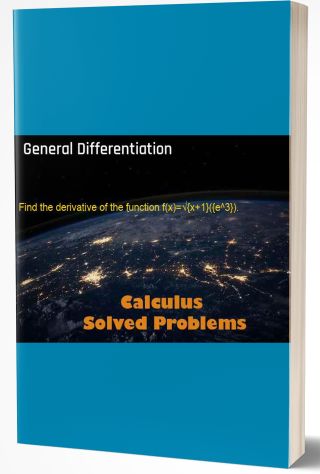
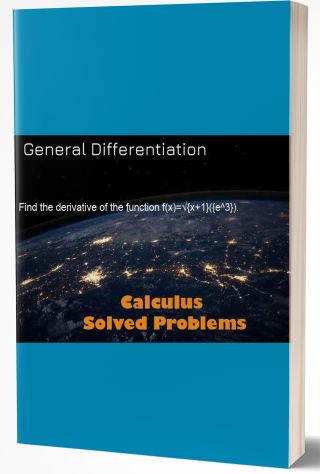
Solution: Find the derivative of the function f(x)=√{x+1}({e^3}). #18523
-
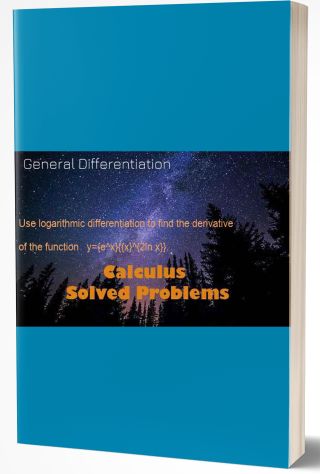
[Solution] Use logarithmic differentiation to find the derivative of the function y={e^x}{{x}^{2ln x}}. #18524
-
[Solution] Find the indefinite integral ∫{(25x^4+4x-3)dx}. #18525
-
[Solution] Find the indefinite integral ∫{(6x^5-4)/(√{{x^6)-4x}}dx}. #18526
-
[Solution] Evaluate the definite integral ∫_0^1{(2x+1)√{x^2+x}dx} #18527
-
(Solved) Evaluate the indefinite integral ∫{t{{(t+2)}^{-6}}dt}. #18530
-
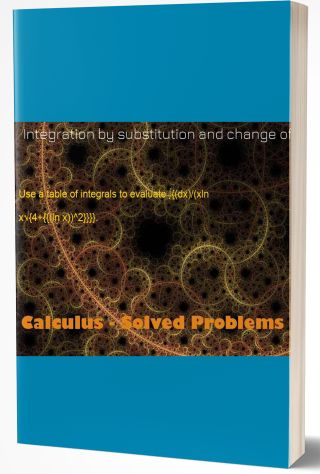
Solution: Use a table of integrals to evaluate ∫{(dx)/(xln x√{4+{{(ln x))^2}}}}. #18531
-
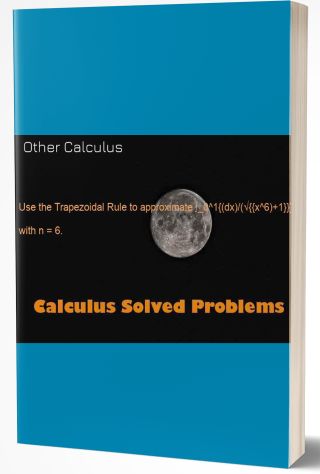
[Solved] Use the Trapezoidal Rule to approximate ∫_0^1{(dx)/(√{{x^6)+1}}} with n = 6. #18532
-
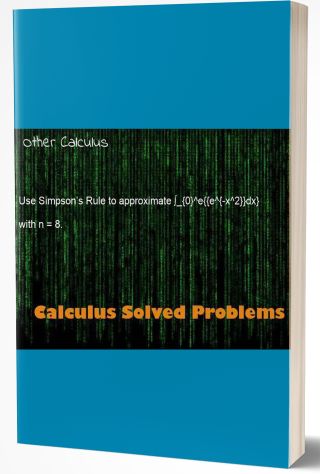
Solution: Use Simpson’s Rule to approximate ∫_{0}^e{{e^{-x^2}}dx} with n = 8. #18533
-
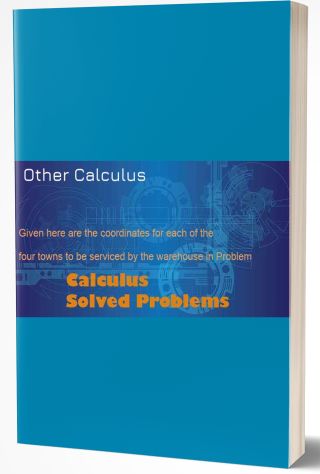
(See Solution) Given here are the coordinates for each of the four towns to be serviced by the warehouse in Problem #18723
-
(See Solution) Find the vector equation and parametric equations for the line through the point (1,0,-3) and parall #18860
-
(See Solution) Find a unit vector that has the same direction as the given vector (9, -5). #18863
-
[Solved] Find the arc length of the curve y=1/3{{(2x-1)}^{3/2}} , 2≤ x≤ 8 #18864
-
[Solution] Find the area of the surface generated by revolving about the y-axis the curve x=2√{4-y}, for #18865
-
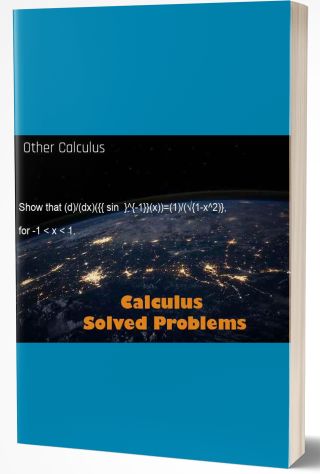
(See Solution) Show that (d)/(dx)({{ sin }^{-1}}(x))=(1)/(√{1-x^2)}, for -1 < x < 1. #18867
-
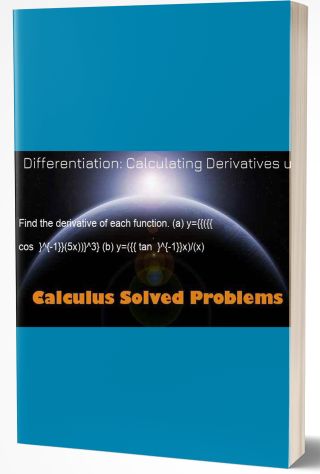
[Solved] Find the derivative of each function. (a) y={{({{ cos }^{-1}}(5x))}^3} (b) y=({{ tan }^{-1}}x)/(x) #18868
-
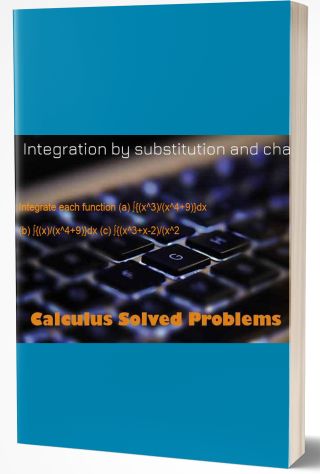
[Solution] Integrate each function (a) ∫{(x^3)/(x^4+9)}dx (b) ∫{(x)/(x^4+9)}dx (c) ∫{(x^3+x-2)/(x^2 #18869
-
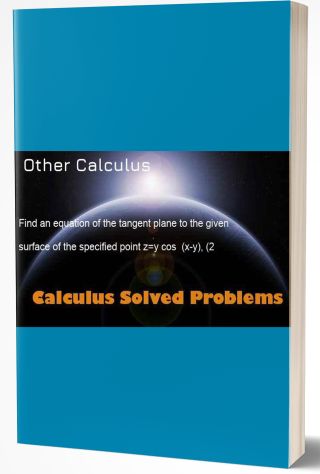
[Solution] Find an equation of the tangent plane to the given surface of the specified point z=y cos (x-y), (2 #18870
-
(Solved) Find the first partial derivative of the function f(x,y)=(x-y)/(x+y) #18871
-
[Solved] Use the Chain Rule to find ?z/?s and the ?z/?t for z= sin θ cos φ , θ =s{t^2},&ph #18872
-
[Solved] Find the directional derivative of the function at the given point in the direction of the vector v. #18873
-
(Solved) Find the maximum rate of change of f at the given point and the direction in which it occurs. f(x,y) #18874
-
[Solved] Use the Chain Rule to find ?u/?x for u=√{{r^2}+{s^2}}, r=y+x cos t, s=x+y sin t. #18876
-
[Solution] Given f(x,y,z)=√{x+yz}, P(1,3,1), u=((1)/(√{3)},(1)/(√{3)},(1)/(√{3)}) #18877
-
Solution: Find the equation of the tangent plane to the given surface at the specified point. x^2-y-z^2=0, (1 #18878
-
(See Solution) Find the Maximum rate of change of f at the given point and in the direction in which it occurs. f(x #18879
-
(See Solution) Find the critical points and the use the second derivative test to determine whether the critical po #18880
-
[Solved] Find the absolute maximum and minimum value of f on the set D where f(x,y)=x+y-x^2-y^2, D={ (x,y) | #18881
-
(See Solution) Test each of the following for convergence or divergence. To get full credit, state the name of any #18882
-
(Solved) Test each of the following for convergence or divergence. To get full credit, state the name of any #18883
-
(Solved) Test each of the following for convergence or divergence. To get full credit, state the name of any #18884
-
[Solved] Test each of the following for convergence or divergence. To get full credit, state the name of any #18885
-
(Solved) Test each of the following for convergence or divergence. To get full credit, state the name of any #18886
-
[Solution] Show that is conditionally convergent. #18887
-
[Solution] Find the interval of convergence of the series #18888
-
[Solution] Find the scalar and vector projections of b onto a, with a = {2, -4, 5}, b = {-1, 2, 3} #18889
-
[Solution] Find parametric equations for the tangent line to the curve with the given parametric equation at th #18894
-
(See Solution) Find the derivative of the vector function r(t)=ln (4-{t^2}){i}+√{1+t}{j}-4{e^{3t}}{k} #18895
-
Solution: Find the velocity, acceleration and speed of a particle with the given position function r(t) = (t #18896
-
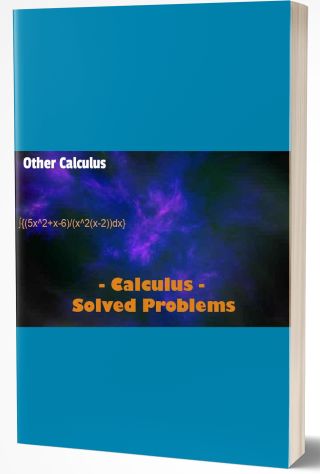
[Solution] ∫{(5x^2+x-6)/(x^2(x-2))dx} #18900
-
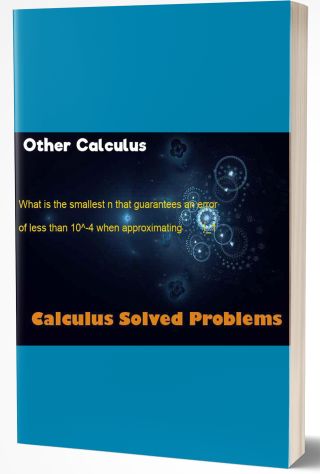
[Solution] What is the smallest n that guarantees an error of less than 10^-4 when approximating ∫_1 #18903
-
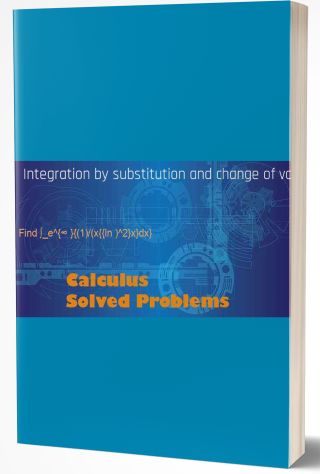
[Solution] Find ∫_e^{∞ }{(1)/(x{{ln )^2}x}dx} #18904
-
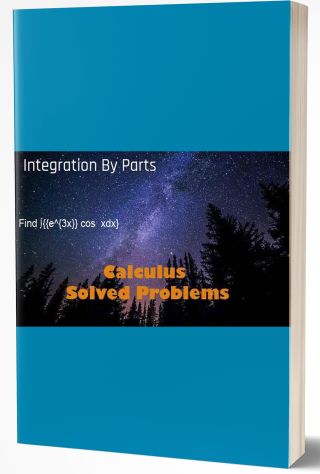
[Solved] Find ∫{{e^{3x}} cos xdx} #18905
-
(See Solution) Sketch the region bounded by the graphs of the algebraic functions and find the area of the region. #18926

In case you have any suggestion, or if you would like to report a broken solver/calculator, please do not hesitate to contact us.