
Solution: The upward velocity of a rocket can be computed by the following formula: v=u ln ((m_0)/(m_0)-q t)-g t where v= upward velocity, u= velocity
Question: The upward velocity of a rocket can be computed by the following formula:
\[v=u \ln \left(\frac{m_{0}}{m_{0}-q t}\right)-g t\]where \(v=\) upward velocity, \(u=\) velocity at which fuel is expelled relative to the rocket, \(m_{0}=\) initial mass of the rocket at time \(t=0, q=\) fuel consumption rate, and \(g=\) downward acceleration of gravity (assumed constant \(\left.=9.8 \mathrm{~m} / \mathrm{s}^{2}\right)\). If \(u=\) \(1800 \mathrm{~m} / \mathrm{s}, m_{0}=160,000 \mathrm{~kg}\), and \(q=2500 \mathrm{~kg} / \mathrm{s}\), determine how high the rocket will fly in \(30 \mathrm{~s}\).
Deliverable: Word Document 
 (Solution Library) You buy a $25,000 piece of equipment for nothing down
![[Solution Library] Many fields of engineering require](/images/solutions/MC-solution-library-56996.jpg "[Solution Library] Many fields of engineering require accurate population estimates.") [Solution Library] Many fields of engineering require accurate population estimates.
[Solution Library] Many fields of engineering require accurate population estimates.
 (All Steps) Use the Newton-Raphson method to find the root of:
![[Step-by-Step] The normal distribution is a bell-shaped](/images/solutions/MC-solution-library-56998.jpg "[Step-by-Step] The normal distribution is a bell-shaped curve defined") [Step-by-Step] The normal distribution is a bell-shaped curve defined
[Step-by-Step] The normal distribution is a bell-shaped curve defined
![[Step-by-Step] A truss is loaded as shown](/images/solutions/MC-solution-library-56999.jpg "[Step-by-Step] A truss is loaded as shown in Fig. P9.15. Using") [Step-by-Step] A truss is loaded as shown in Fig. P9.15. Using
[Step-by-Step] A truss is loaded as shown in Fig. P9.15. Using
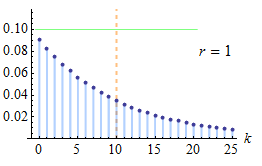 Geometric Probability Calculator - MathCracker.com