
(See Solution) Suppose that f is continuous on [ a, b ] and differentiable on (a , b), and that f'(x) is never zero at any point on (a , b). Explain
Question: Suppose that f is continuous on [ a, b ] and differentiable on ( a , b ), and that \(f'\left( x \right)\) is never zero at any point on ( a , b ). Explain why the maximum and minimum values must occur at the endpoints of the interval [ a , b ].
Deliverable: Word Document 
 (Step-by-Step) A stone dropped into a pond at time t = 0 causes a
![[Solution] Find the maximum possible area of](/images/solutions/MC-solution-library-35533.jpg "[Solution] Find the maximum possible area of a rectangle of perimeter") [Solution] Find the maximum possible area of a rectangle of perimeter
[Solution] Find the maximum possible area of a rectangle of perimeter
 (Solution Library) A rectangle of fixed perimeter 36 is rotated about
 Solution: Suppose that you are to make a rectangular box with
![[Solution Library] Find the shape of the](/images/solutions/MC-solution-library-35536.jpg "[Solution Library] Find the shape of the cylinder of maximal volume") [Solution Library] Find the shape of the cylinder of maximal volume
[Solution Library] Find the shape of the cylinder of maximal volume
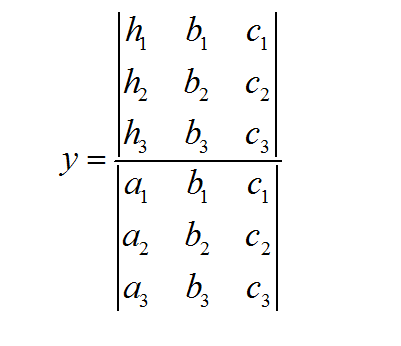 Cramer's Rule for Solving Linear Systems of Equations - Mathcracker.com