
[See Steps] One proof of the Pythagorean Theorem involves expressing algebraically the areas of the two squares given below and equating the results. Notice
Question: One proof of the Pythagorean Theorem involves expressing algebraically the areas of the two squares given below and equating the results. Notice that each contains copies of a right triangle with legs measuring \(a\) and \(b\) and hypotenuse measuring \(c\). Note that both squares have sides of length \(a+b\) making both areas \((a+b)^{2}\). Using this information, show that \(a^{2}+b^{2}=c^{2}\).


Deliverable: Word Document 
![[See Solution] Use the quadrilateral VWXZ If](/images/solutions/MC-solution-library-66719.jpg "[See Solution] Use the quadrilateral VWXZ If one angle of a parallelogram") [See Solution] Use the quadrilateral VWXZ If one angle of a parallelogram
[See Solution] Use the quadrilateral VWXZ If one angle of a parallelogram
 (All Steps) Refer to the figure of a kite. What kind of triangle
![[Solution Library] Given: ABCD is a rhombus](/images/solutions/MC-solution-library-66721.jpg "[Solution Library] Given: ABCD is a rhombus B E#772; \perp A D#772;") [Solution Library] Given: ABCD is a rhombus B E#772; \perp A D#772;
[Solution Library] Given: ABCD is a rhombus B E#772; \perp A D#772;
![[Solution Library] In \triangle A B C,](/images/solutions/MC-solution-library-66722.jpg "[Solution Library] In \triangle A B C, X and Y are midpoints of") [Solution Library] In \triangle A B C, X and Y are midpoints of
[Solution Library] In \triangle A B C, X and Y are midpoints of
 (All Steps) If W X=5 x+3 and Z Y=13 x-1 and A B=6 x+7, find
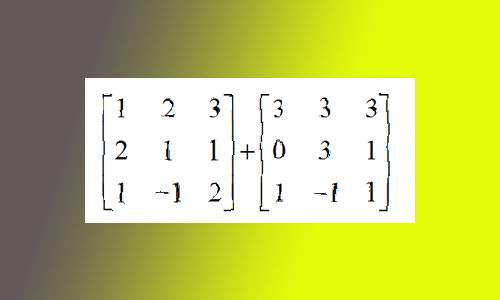 Sum of Matrices Calculator - MathCracker.com