
[Solution Library] Let X_1, X_2, ..., X_m be an independent random sample of size m from N(μ_1, σ_1), and let Y_1, Y_2, ..., Y_n be another independent
Question: Let \(X_{1}, X_{2}, \ldots, X_{m}\) be an independent random sample of size \(\mathrm{m}\) from \(N\left(\mu_{1}, \sigma_{1}\right)\), and let \(Y_{1}, Y_{2}, \ldots, Y_{n}\) be another independent random sample of size n from \(N\left(\mu_{2}, \sigma_{2}\right)\) and The two samples are independent. The difference between the sample means, \(\bar{X}-\bar{Y}\), is then a linear combination of \(\mathrm{m}+\mathrm{n}\) normal random variables.
- Find \(E(\bar{X}-\bar{Y})\)
- Find \(\operatorname{Var}(\bar{X}-\bar{Y})\)
- Use the \(m \cdot g, f^{\prime} s\) to show that the distribution \(o \bar{X}-\bar{Y} f\) is normal with mean and standard deviation equal to the answers of part a and b respectively.
- Suppose that \(\sigma_{1}=\sqrt{2}\) and \(\sigma_{2}=\sqrt{2.5}\) and \(m=n .\) Find the sample sizes such that \(\bar{X}-\bar{Y}\) will be within one unit of \(\mu_{1}-\mu_{1}\) with a probability of 0.95
Deliverable: Word Document 
![[Solution Library] Let Z_1, Z_2, ..., Z_16](/images/solutions/MC-solution-library-71876.jpg "[Solution Library] Let Z_1, Z_2, ..., Z_16 be an independent random sample") [Solution Library] Let Z_1, Z_2, ..., Z_16 be an independent random sample
[Solution Library] Let Z_1, Z_2, ..., Z_16 be an independent random sample
 (See) Let Z_1, Z_2, ..., Z_16 be an independent random sample
![[All Steps] (a) (4 points) For the](/images/solutions/MC-solution-library-71878.jpg "[All Steps] (a) (4 points) For the path parameterized by r(t)=t") [All Steps] (a) (4 points) For the path parameterized by r(t)=t
[All Steps] (a) (4 points) For the path parameterized by r(t)=t
 (Solution Library) Let F=(a x^2 y+y^3+1) i+(2 x^3+b x y^2+2) j
![[Solution Library] (a) (3 points) Find the](/images/solutions/MC-solution-library-71880.jpg "[Solution Library] (a) (3 points) Find the arc length of the curve") [Solution Library] (a) (3 points) Find the arc length of the curve
[Solution Library] (a) (3 points) Find the arc length of the curve
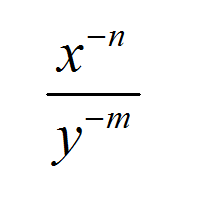 Operations with Negative Exponents - MathCracker.com