
[See Steps] The cross-tabulation table below reveals some characteristics for the population. For example, of the 19 persons, 63% are Male, and 74% are
Question: The cross-tabulation table below reveals some characteristics for the population. For example, of the 19 persons, 63% are Male, and 74% are married.
| Gender | ||||
| Married | F | M | Total | % |
| N | 3 | 2 | 5 | 26% |
| Y | 4 | 10 | 14 | 74% |
| Total | 7 | 12 | 19 | |
| % | 37% | 63% | 100% | |
Compute from these data the following conditional probabilities for a person drawn at random from this population:
- Probability that a Female person is married:
- Probability that a Married person is Male:
-
Assume that the ‘Chi-Squared’ statistic computed for this 2-by-2 table is 1.56.
What does this imply about the reliability of this evidence which suggests a relationship between Marital Status and Gender in the population from which these 19 persons are a representative sample? - What if the same proportional results were based on a sample ten-times larger; that is of 190 persons of which 40 were Married Females, etc.? How would the Chi-Squared test of statistical significance be different?
Deliverable: Word Document 
 (Solution Library) Recall our analysis of the data on Condo sales,
![[All Steps] Each coffee table produced by](/images/solutions/MC-solution-library-40705.jpg "[All Steps] Each coffee table produced by Robert West Designers net") [All Steps] Each coffee table produced by Robert West Designers net
[All Steps] Each coffee table produced by Robert West Designers net
 (See Steps) Maggie Moylan Motorcycle Corp. uses kanbans to support
 (Solution Library) Based on the following information, complete a
![[Solution] The American Sugar Producers Association wants](/images/solutions/MC-solution-library-40708.jpg "[Solution] The American Sugar Producers Association wants to estimate") [Solution] The American Sugar Producers Association wants to estimate
[Solution] The American Sugar Producers Association wants to estimate
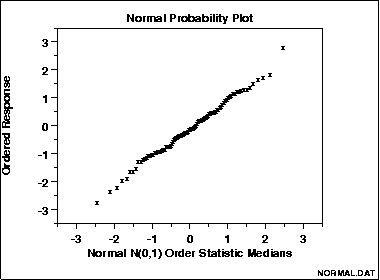 Normal Probability Plot Maker - MathCracker.com