
[Solution Library] Consider a consumer who lives for two periods. The first period income is m_1, the second period income is m_2. Denote the consumer's
Question: Consider a consumer who lives for two periods. The first period income is \(m_{1}\), the second period income is \(m_{2}\). Denote the consumer's consumption in the first period and second period by \(c_{1}, c_{2}\), respectively. The consumer's preferences are given by \(\sqrt{c_{1}}+\delta \sqrt{c_{2}}\).
- Write down the consumer's choice problem.
- Derive the first order condition and characterize the solution.
- What is the solution to the problem if \(\delta=0\) ? What is the solution if \(\delta=1\) ? explain.
- For general \(0<\delta<1\), is it possible that the consumer's consumption in each period is the same (that it, the solution is \(\left.c_{1}^{*}=c_{2}^{*}\right) ?\) If it is, find the conditions under which this is the solution.
Deliverable: Word Document 
 (Step-by-Step) Repeat question 2 when the preferences are given
 Solution: Consider preferences described by U(x_1, x_2)=min 4
 (See Solution) Find the probability that a random z-score will
 (See Solution) According to the CLT, of individual observations of
![[Steps Shown] In a large population of](/images/solutions/MC-solution-library-32907.jpg "[Steps Shown] In a large population of college graduates, the") [Steps Shown] In a large population of college graduates, the
[Steps Shown] In a large population of college graduates, the
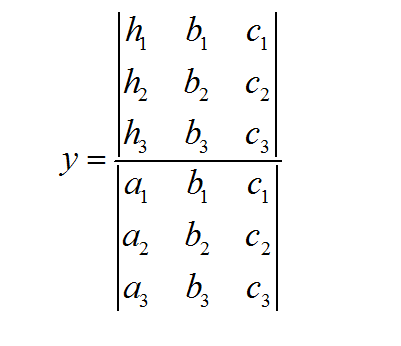 Cramer's Rule for Solving Linear Systems of Equations - Mathcracker.com