Recall the basic population model discussed in class \beginaligned (dN)/(dt)=rN , N(0)=N_0 , \endaligned
Recall the basic population model discussed in class
\(\left\{ \begin{aligned}
& \frac{dN}{dt}=rN \\
& N\left( 0 \right)={{N}_{0}} \\
\end{aligned} \right.\)
with parameter No and r. We would like to fit this model to the data given by

In class we showed that using two data points to find values of these parameters produced greater than 2% error for other data points.
- Your first task is to adjust the model to better fit the data. Your goal is to choose parameter No and r that fits the data to within 2% relative error. To accomplish this you can use a least squares best lit (or a similar best fit procedure).
- Use the adjusted model to predict the number of cells on the 9th, 14th, and 21st day.
- Propose some concrete ways in which the basic model can be compounded. Consider the simplifying assumptions made for this model. With each proposed action answer two questions
a.) Why is this proposed action reasonable?
b.) Why would this proposed action compound the model?
Price: $6.5
Solution: The downloadable solution consists of 3 pages, 350 words and 1 charts.
Deliverable: Word Document
Deliverable: Word Document
-
 (See Solution) Complete "Example 13.2: Process Control Chart Design,"
-
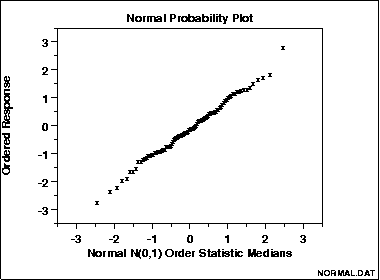
[Solution Library] (a) Assess ANOVA assumptions using the graph from
-
(Step-by-Step) Discussion Board 4.2 Several different types of
-
[Step-by-Step] Discussion Board 5.2 Discussion 2: Discuss the usefulness
-
[See Steps] : Learning Objective: The purpose of this part of
-
Correlation Coefficient Calculator Using Z-score - MathCracker.com

![[Solution Library] (a) Assess ANOVA assumptions using](/images/solutions/MC-solution-library-82915.jpg "[Solution Library] (a) Assess ANOVA assumptions using the graph from")

![[Step-by-Step] Discussion Board 5.2 Discussion 2: Discuss](/images/solutions/MC-solution-library-82917.jpg "[Step-by-Step] Discussion Board 5.2 Discussion 2: Discuss the usefulness")
![[See Steps] : Learning Objective: The purpose](/images/solutions/MC-solution-library-82918.jpg "[See Steps] : Learning Objective: The purpose of this part of")