[Solved] First, some questions that have nothing to do with labour - #80077
First, some questions that have nothing to do with labour economics, but will give you some practice applying economic concepts that you know.
1. Felix has a budget of $60. He needs your help deciding how to spend it. He lives in a small town, and there are only two goods available for purchase. The two goods are lattes (Starbucks is everywhere!) and movies. Lattes cost $5 each, and movies cost $10 each.
a. Draw Felix’s budget line with lattes on the horizontal axis. What is its slope?
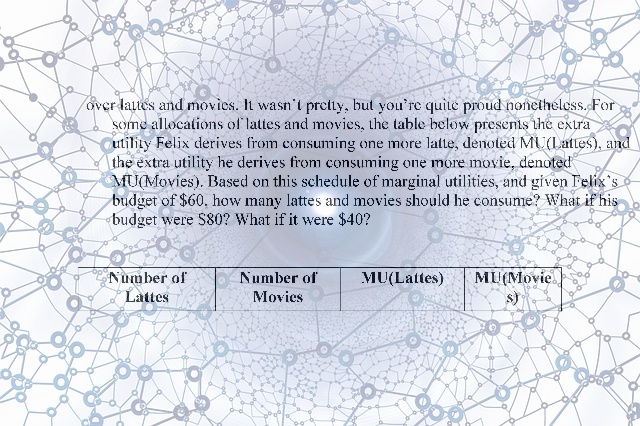
b. You try very hard to elicit Felix’s preferences. After hours of probing questions, you find that you can construct a schedule of his marginal utilities over lattes and movies. It wasn’t pretty, but you’re quite proud nonetheless. For some allocations of lattes and movies, the table below presents the extra utility Felix derives from consuming one more latte, denoted MU(Lattes), and the extra utility he derives from consuming one more movie, denoted MU(Movies). Based on this schedule of marginal utilities, and given Felix’s budget of $60, how many lattes and movies should he consume? What if his budget were $80? What if it were $40?
|
Number of Lattes |
Number of Movies |
MU(Lattes) |
MU(Movies) |
|
0 |
4 |
4 |
0 |
|
0 |
6 |
6 |
0 |
|
2 |
3 |
3 |
2 |
|
2 |
5 |
5 |
2 |
|
4 |
2 |
2 |
4 |
|
4 |
4 |
4 |
4 |
|
4 |
6 |
6 |
4 |
|
6 |
1 |
1 |
6 |
|
6 |
3 |
3 |
6 |
|
6 |
5 |
5 |
6 |
|
8 |
0 |
0 |
8 |
|
8 |
2 |
2 |
8 |
|
8 |
4 |
4 |
8 |
|
10 |
1 |
1 |
10 |
|
10 |
3 |
3 |
10 |
|
12 |
0 |
0 |
12 |
|
12 |
2 |
2 |
12 |
|
14 |
1 |
1 |
14 |
|
16 |
0 |
0 |
16 |
(2) Using the demand and supply curves, draw a market diagram to illustrate the impact of the following:
a) an increase in lumber prices on the market for new homes
b) the aging of the baby-boom generation on the market for healthcare
c) an increase in consumer incomes on the market for restaurant meals
d) a freezing spell in Florida on the market for Orange in Canada.
3. In November of 2001 the government of BC introduced a “subminimum” wage of $6/hr. We talked about it in class, remember? The new subminimum applies only to individuals hired on or after Nov. 15, 2001 who had no paid work experience prior to that day. After workers accumulate 500 hours of paid work experience they are entitled to the regular minimum wage of $8/hr.
a. Identify an industry and occupation where workers are usually hired at the minimum wage. In the context of this labour market, identify who benefits from this policy change and who is hurt by it (“winners and losers”). Don’t forget about consumers. Illustrate your argument using supply and demand curves. Assume that workers who are subject to the subminimum wage are perfect substitutes for those who are not.
b. What if they are not perfect substitutes?
Deliverable: Word Document
 and pdf