Solution: 1) An open-top box is to be constructed from a 6 by - #80220
Part I
1) An open-top box is to be constructed from a 6 by 8 foot rectangular cardboard by cutting out equal squares at each corner and the folding up the flaps. Let x denote the length of each side of the square to be cut out.
a) Find the function V that represents the volume of the box in terms of x.
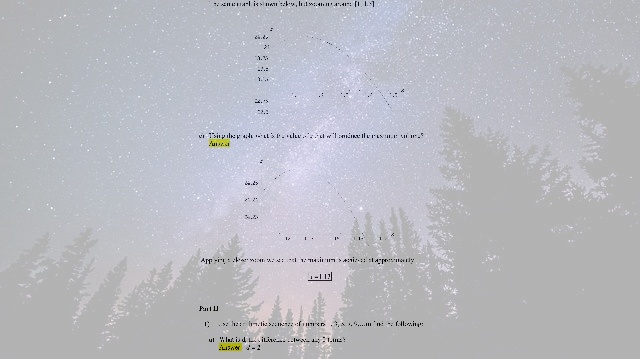
b) Graph this function and show the graph over the valid range of the variable x..
c) Using the graph, what is the value of x that will produce the maximum volume?
Part II
1) Use the arithmetic sequence of numbers 1, 3, 5, 7, 9,…to find the following:
a) What is d, the difference between any 2 terms?
b) Using the formula for the nth term of an arithmetic sequence, what is 101st term?
c) Using the formula for the sum of an arithmetic series, what is the sum of the first 20 terms?
d) Using the formula for the sum of an arithmetic series, what is the sum of the first 30 terms?
e) What observation can you make about these sums of this series (HINT: It would be beneficial to find a few more sums like the sum of the first 2, then the first 3, etc.)? Express your observations as a general formula in "n."
2) Use the geometric sequence of numbers 1, 2, 4, 8,…to find the following:
a) What is r, the ratio between 2 consecutive terms?
b) Using the formula for the nth term of a geometric sequence, what is the 24th term?
c) Using the formula for the sum of a geometric series, what is the sum of the first 10 terms?
3) Use the geometric sequence of numbers 1, 1/2, 1/4, 1/8,…to find the following:
a) What is r, the ratio between 2 consecutive terms?
b) Using the formula for the sum of the first n terms of a geometric series, what is the sum of the first 10 terms? Please round your answer to 4 decimals.
c) Using the formula for the sum of the first n terms of a geometric series, what is the sum of the first 12 terms? Please round your answer to 4 decimals.
d) What observation can make about these sums? In particular, what number does it appear that the sum will always be smaller than?
4) CLASSIC PROBLEM - A traveling salesman (selling shoes) stops at a farm in the Midwest. Before he could knock on the door, he noticed an old truck on fire. He rushed over and pulled a young lady out of the flaming truck. Farmer Brown came out and gratefully thanked the traveling salesman for saving his daughter’s life. Mr. Brown insisted on giving the man an award for his heroism.
So, the salesman said, “If you insist, I do not want much. Get your checkerboard and place one penny on the first square. Then place two pennies on the next square. Then place four pennies on the third square. Continue this until all 64 squares are covered with pennies.” As he’d been saving pennies for over 25 years, Mr. Brown did not consider this much of an award, but soon realized he made a miscalculation on the amount of money involved.
a) How much money expressed in dollars would Mr. Brown have to put on the 32nd square?
b) How much money expressed in dollars would the traveling salesman receive in total if the checkerboard only had 32 squares?
c) Calculate the amount of money necessary to fill the whole checkerboard (64 squares). How money expressed in dollars would the farmer need to give the salesman?
Deliverable: Word Document
 and pdf