
Artificial‑intelligence tools now help make math feel easier. Learners see quick feedback through adaptive tutors, OCR‑powered apps, and visual tools. These tools help each student, figure out questions from photos or handwriting, and show solutions with visuals.

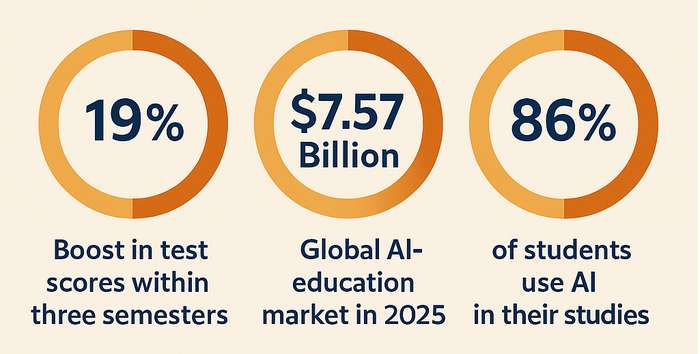
AI in classrooms boosts test scores by 19% within three semesters, and students using AI learning tools outperform peers by an average of 12.4%. The global AI‑education market is projected to hit $7.57 billion in 2025. Also, 86% of students now use AI in their studies, and over half use it at least once a week.
This article explores how smart AI platforms simplify math learning. It sets out to show what different AI tools can do, why they help, and what learners and teachers need to know. The goal is to give readers a clear picture of AI’s role in making math more personal and accessible.
Benefits of Intelligent AI Platforms for Learners
Back in the 20th century, math learning relied on textbooks, lectures, and paper worksheets. Teachers led the class at one pace. Students waited for graded homework to get feedback. Now, AI tools can adapt in real time. They respond instantly and adjust to each learner.
Traditional paper worksheets are static and often take a 'one-size-fits-all' approach. Students complete identical problems regardless of their specific ability, and without immediate corrections, they risk practicing the same mistake over and over until a teacher provides a correction or eventually grades the work.
Today’s tech lets students interact with math using computers or smartphones. Research shows the difference. One US study split students between interactive digital tools and classic worksheets. Those using tailored digital tools improved by 24.2%, while the worksheet group rose only 8.3%. That shows modern tech can speed up personalized learning.
AI also lifts student outcomes across many settings. Schools using AI‑driven math apps saw test scores jump 19% in just three semesters. With AI, learners get timely, personal help. They can move ahead faster or catch up where they struggle.
- Smart feedback reduces frustration and builds confidence. When students see where they go wrong and get it fixed right away, they stay engaged.
Personalized Help and Instant Feedback
AI platforms can adjust their help to each student’s level, guiding one step at a time and offering feedback instantly.
☆ For example, a student stuck on algebra can scan a problem. The app will show the full solution and point out where mistakes happened. The student sees the correct method right away. That helps learners stay on track and correct misconceptions quickly.
Less Frustration, More Confidence
Hard math problems can feel overwhelming. When AI breaks a question into smaller, intuitive parts, learners feel less stuck. Say a student struggles to factor a quadratic. AI gives hints and shows each step. The student gains clarity and gets confident when seeing the solution unfold. Motivation grows too.
Broad Access and Cost Efficiency
Artificial intelligence can scale to many learners at low cost, even where resources are limited. With internet access, students can connect to math support from almost any part of the world. Some platforms offer free versions or low-cost options, which makes them realistic for schools and families with fewer resources. High-quality math help is no longer limited to certain countries or wealthier families.
Modern AI Tools That Simplify Math
Every AI tool for math shares core traits. They read student input from a photo or typed text. Then, build an understanding of the problem. Programs offer step‑by‑step explanation, hints, or related examples. They may even adapt to the learner’s past errors.
Mathematics is tricky to teach using AI. It requires logic, symbolic reasoning, and precise steps. To build these tools, developers must train systems on math problems and solutions, teach them to recognize symbols and handwriting, and create methods to show a solution path.
☆ For example, a tool might scan a handwritten problem, identify that it’s a quadratic equation, compute factors, and then present a simple explanation. It needs both OCR skills and math logic.
QANDA: Smart Scanning Meets AI
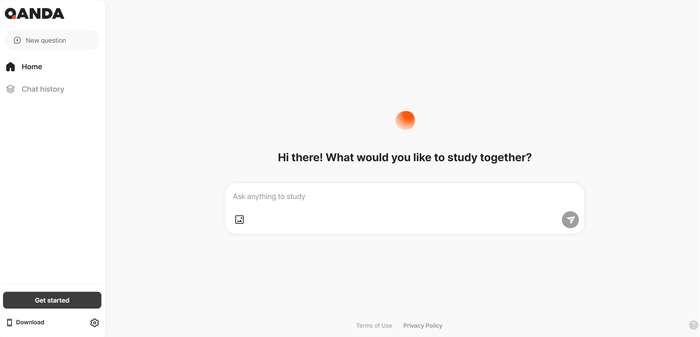
QANDA uses OCR to scan math problems and then walks learners through full solutions. As of March 2024, it solved over 6.3 billion questions. It serves 90 million registered users, with 8 million monthly active users in 50 countries.
It has a chat‑style interface. You snap a photo or type a problem. AI explains the steps. It also offers concept review, quizzes, and auto‑grading of student work. In early 2024, QANDA’s in‑house MathGPT model topped prior benchmarks like ToRA 13B on math tests.
Pricing: QANDA is free to start. Premium plans unlock more features such as unlimited micro-video lectures and one-on-one tutoring. Prices range from about $5.99 per month for Pro to $12-15 per month for Premium subscriptions.
Pros
- Fast OCR scanning
- Detailed step explanation
- Chat interface
- Quiz and review tools
Cons
- Premium features require subscription
- OCR may struggle with messy handwriting
Help for Everyone with AskTutor AI
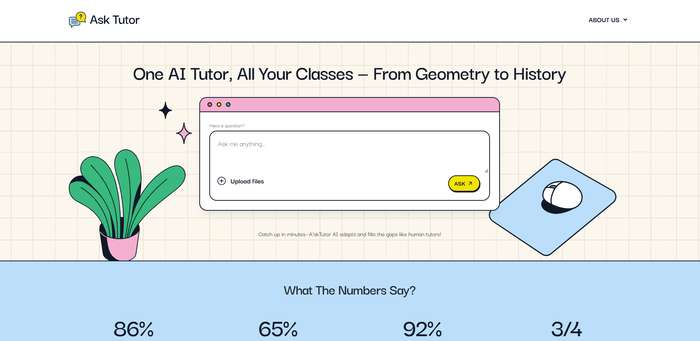
This AI math tutor lets you ask a math question like you're chatting and get help. It can solve problems, explain concepts, and generate practice quizzes. The interface feels like texting a tutor.
Asktutor helps when a student cannot solve a problem. The tool fits the level of each learner, from basic sums to calculus. It breaks tough topics into easy steps and adapts to how you study. You can upload files (txt, pdf, doc, png, jpeg, jpg) to ask questions, up to 10,000 characters or 32MB in size. Students can use the Asktutor anytime and get an answer. This tutor AI also gives practice tasks and step-by-step help. With AI-powered assistance, learners fix mistakes faster and keep improving with steady progress.
☆ Example: A user types a calculus derivative problem. Asktutor AI shows steps, explains the derivative rules, and gives another similar practice question.
It seems free to try. More advanced features may require a subscription but pricing details are not publicly shown. It supports problem input, explanation, and practice generation.
Pros
- Conversational interface
- Concept explanations plus practice
- Easy to use like texting
- Free to use
Cons
- No data on depth or accuracy publicly available
Photomath
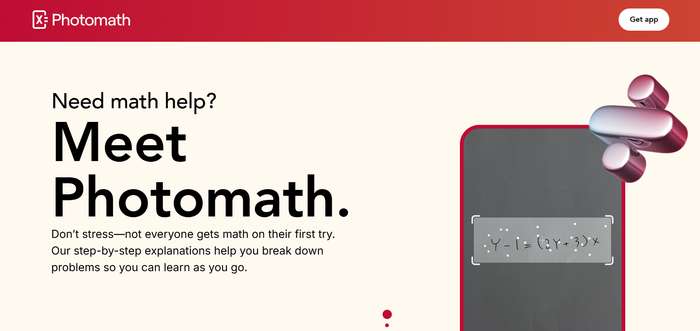
The program lets users snap math problems with a phone camera – printed or handwritten. It shows step‑by‑step explanations using its algebra engine. The app covers basic math, algebra, geometry, trigonometry, statistics, and calculus Photomath has over 220 million downloads and solves 2.2 billion science problems monthly. It was acquired by Google in 2023, after starting as a tool by Microblink in 2014
It is free to start, with a “Photomath Plus” subscription for more features like word‑problem solving and textbook-exercise help. Pricing starts at $9.99 per month or about $60 per year, offering discounts for longer-term plans.
Pros
- Scans both printed and handwritten math
- Basic features are free
- Animated tutorials and textbook help with Plus
Cons
- Premium features behind paywall
- Relies on internet to process problems
AI Tutoring at Scale with Skye
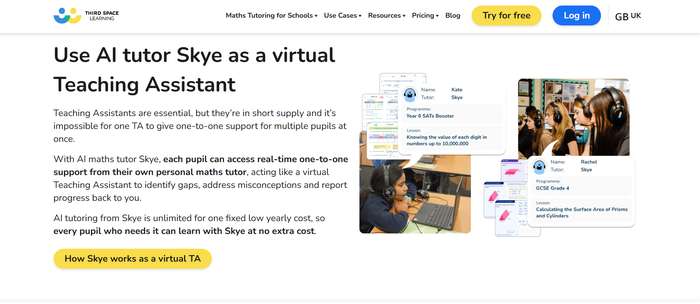
An innovative AI tutor from Third Space Learning, built on insights from over two million one‑on‑one tutoring sessions. Skye offers real‑time support at scale, often used in schools to supplement teaching. Skye adapts to each student. It begins with a short diagnostic check. Then it picks the right path: quick practice for confident learners, or step-by-step help where needed. Teachers receive reports, lesson plans, and progress data.
Skye is cost-effective. In the UK, it starts at £3,500 per year for a small primary school. In the US, prices range from $5,000 to $15,000 per year depending on school size. These fixed plans cover unlimited students and tutoring sessions. Schools save up to 90% compared with traditional private tutoring.
Pros
- Real-time, one-on-one style support
- Built on millions of tutoring hours of real data
- Unlimited sessions and flexible scheduling
- Progress reporting
Cons
- Only available through school contracts
- Pricing varies and requires school-level approval
- Not accessible to independent learners
Adaptive Learning with Squirrel AI
It breaks math into very small learning points and builds lessons around what each student needs. It uses a system called IALS (Intelligent Adaptive Learning System) that maps thousands of tiny "knowledge points". For instance, basic topics and the Pythagorean theorem. So lessons can be precise and targeted. Each learner starts with a diagnostic test. The system then directs them toward the next topic.
Squirrel AI uses the Large Adaptive Model (LAM), launched in January 2024. This model boosts accuracy in answering questions, raising it from about 78% to roughly 93%. Its training relies on data from over 24 million students and 10 billion learning behaviors.
Pricing usually depends on institutions. It works via learning centers, and families pay a flat enrollment fee similar to a gym membership.
Pros
- Very fine-grained lessons based on tiny knowledge points
- Adaptive pacing based on mastery
- Tracking of progress and mastery levels
Cons
- Not available for free
- Set-up and access involving school or center
ALEKS
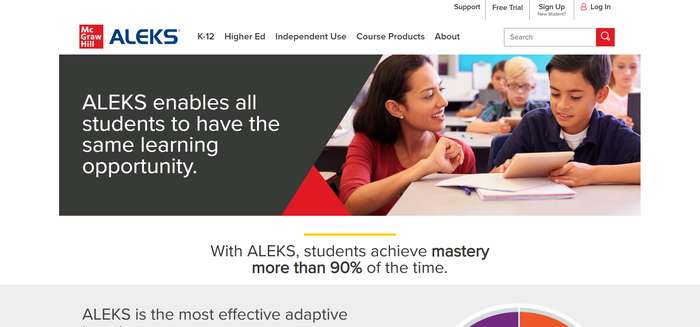
The system called Assessment and Learning in Knowledge Spaces first gives a short test. Then it finds out what the student already knows. It uses a knowledge‑space model to plan what the student is ready to learn next and suggests topics at the right level. It covers many subjects, from arithmetic to pre‑calculus, chemistry, and statistics.
ALEKS also gives fast feedback. As the student works, the system shows progress in real time. It uses data from billions of past questions and trusted learning theory to make those suggestions accurate.
Cost: ALEKS is subscription-based. For families, individual plans start at about $19.95 per month, $99.95 for 6 months, or $179.95 per year.
Pros
- Pinpoints what the student is ready to learn next
- Covers a wide range of courses from K-12 to college prep
Cons
- Requires paying a subscription
- Interface looks a bit old-fashioned
Chat-Based Tutor Rori
This is a free AI math tutor that runs on WhatsApp. It was made for Upper Primary and Junior High students in Ghana and Sierra Leone. Students chat with it in their own words. Rori gives micro-lessons, practice questions, hints, and explained answers. It works on low-cost phones and uses very little data.
A study over eight months with grades 3-9 found Rori made a big difference. Students who used it twice a week, in 30-minute sessions, gained more in math. Rori reached over 150,000 students across Ghana, Sierra Leone, Nigeria, Kenya, and Rwanda. It produced about a 0.3 standard deviation gain in learning outcomes.
Pros
- Works on basic phones via WhatsApp
- Shows clear learning gains backed by data
- Free to use for students, low cost for organizations
Cons
- Only works on WhatsApp
- Less interactive than a full app
- Requires setup and oversight by schools or programs
Classroom-Level AI Advances
AI helps teachers save time on admin tasks and focus on teaching. Nearly 60% of U.S. principals now use AI tools, and chatbots answer student questions 24/7. Educators also use AI to design engaging lessons and track student progress. A Financial Times report notes AI frees teachers to personalize instruction and monitor learners like a sat‑nav guiding progress.
Recent news highlights AI‑first schools emerging. One in Virginia charges $65,000 a year for a program where children learn with adaptive apps and "guides" instead of traditional teachers. The school reports students learn twice as much as traditional classrooms.
Next-Gen AI Visual Tools
Future AI will offer live visuals, dynamic lesson plans, and deeper engagement. For example, new tools generate interactive math animations on the fly – like showing fractions stacking in real time. Others craft personalized visual hints based on student mistakes.
Here's a small table of innovative tools:
| Tool Name | What It Does |
| MathViz | Live algebra animation and manipulation |
| Tutor-Bot 3D | 3D geometry tutor with interactive models |
| LessonCraft AI | AI-generated visual lesson plans |
Conclusion
AI makes math more personal, interactive, and widely accessible. It gives learners instant help, builds confidence, and reaches students everywhere. Yet it works best when paired with human guidance, checks, and thoughtful use. Not much time has passed since the rapid development of artificial intelligence, but studying mathematics has become easier already.
In case you have any suggestion, or if you would like to report a broken solver/calculator, please do not hesitate to contact us .